Summer School: Foundations of Psychoanalytic & Jungian Psychotherapy
Intensive Online Programme
Course length: 4.5 Days
Course Dates: to be announced.
Standard fee: £1350
This 4.5-day intensive summer school offers a rigorous yet accessible introduction to the essential concepts and cultural significance of psychoanalytic and Jungian psychotherapy, with a particular emphasis on the emotional and developmental life cycle. Participants will explore how psychoanalytic and Jungian ideas illuminate the unfolding of human development—from infancy through childhood and adolescence, into adulthood, couple relationships, and later life.
The course is led by senior psychoanalytic and Jungian clinicians whose work spans this full developmental spectrum, including direct experience with children and adolescents, adults, couples, and parents and infants. Their breadth of practice ensures that the theories and concepts explored throughout the programme are rooted in real-world clinical understanding and the lived developmental challenges encountered across the lifespan.
Bringing together foundational theory with reflective discussion, the programme offers a rare opportunity to engage deeply with the ways inner experience evolves across time: how patterns are formed, how symbolic life shapes our development, and how unconscious processes influence the relationships we build and the difficulties we meet.
Applications for the 2027 will open in Autumn 2026.
Course dates: to be announced.
Contact: [email protected]
View Lecture Previews
Human Development and the Lifespan – Dr Zack Eleftheriadou
Jung’s Concept of Self as the Directing, Central Archetype of Psyche – Mark Matthew Palmer, Jungian Analyst and Psychotherapist
Watch Open Day Presentation:
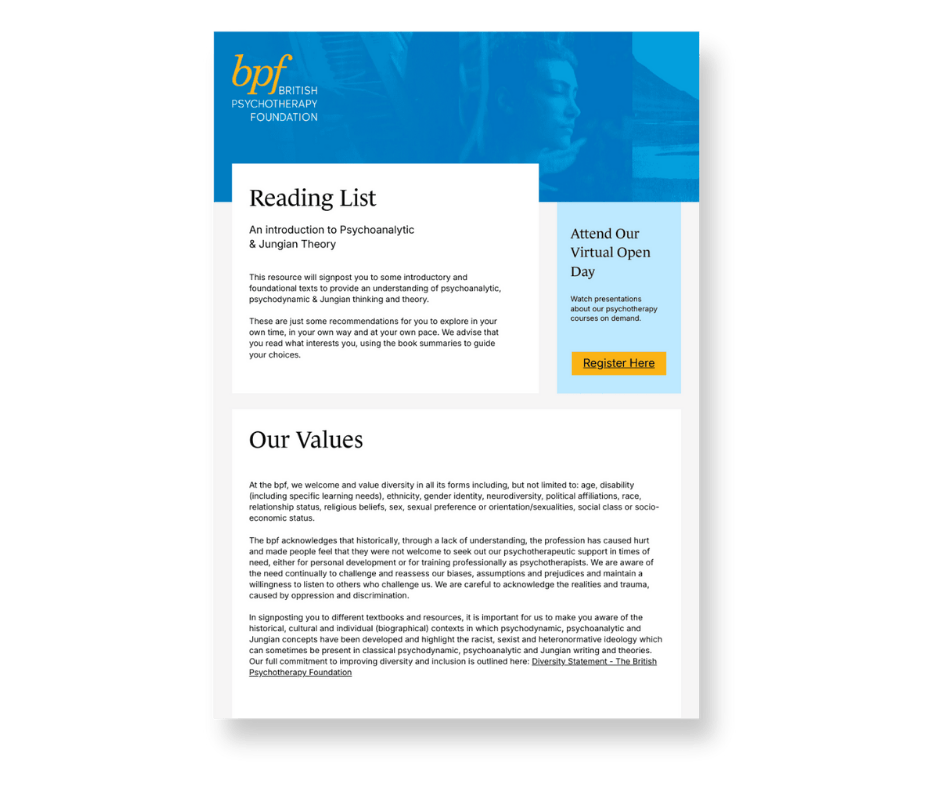
Download Free Reading List
This reading list highlights six key texts that offer an introduction to psychoanalytic, psychodynamic, and Jungian theory.
- Course Content
- Who Is This For?
- Course content
- Structure and Approach
- Fees
- How to apply
The aim of the summer school is to offer a grounded and coherent introduction to psychoanalytic and Jungian ideas, presented in ways that speak directly to the developmental journey of the human psyche. Participants will gain an understanding of how unconscious processes, symbolic experience, relational dynamics, and early emotional life shape the development of the self over time. Emphasis is placed on helping participants think about how these ideas play out across the lifespan—from infancy and childhood to adulthood, couple relationships, and later life.
Throughout the programme, time is set aside for reflective discussion, helping participants think through how these concepts relate to their own experiences and to broader cultural and developmental themes. For those considering further study, the course provides valuable insight into psychoanalytic training pathways at the British Psychotherapy Foundation. A certificate of completion is offered to participants who attend at least 80% of sessions.
Lecture Preview:
This summer school is suitable for anyone with an interest in psychoanalytic or Jungian thought, regardless of background or prior study. It is particularly valuable for people at the beginning of their exploration of psychotherapy, especially those who may be considering applying for a bpf training and want a structured way to engage with the core ideas.
The course also welcomes individuals interested in understanding their own emotional and developmental history, including how patterns form in childhood, adolescence, adulthood, and relationships. Students, professionals, or researchers in related fields—such as psychology, education, health and social care, the arts, or the humanities—may find that the developmental focus provides a useful theoretical backbone for their existing work. More broadly, the programme is well-suited to anyone drawn to the inner world, symbolism, and the evolving nature of psychic life across time.
The course is taught online in English. Fluency in English will be required in order to join the course. This intensive course contains no written work, but is taught at a postgraduate level.
The summer school explores a rich and structured range of material, always with reference to the unfolding of psychological life across the developmental lifespan. Participants begin by examining the origins of psychoanalysis, including Freud’s foundational ideas about the formation of the psyche, early relational experience, dream life, and the workings of repression, transference, and unconscious processes throughout life. These foundational frameworks form the basis for understanding how development is shaped from infancy onward.
The programme then moves into Jungian perspectives, exploring central concepts such as archetypes, the collective unconscious, symbolic life, and the process of individuation. Jung’s attention to developmental transitions—including the shifts of adolescence, midlife, creativity, and later life—provides a rich complement to psychoanalytic models of growth.
Further sessions consider the therapeutic relationship as a developmental space, where early patterns, attachment templates, and unconscious dynamics can be expressed, understood, and transformed. Contemporary perspectives introduce interdisciplinary insights from neuroscience, culture, and developmental psychology, enabling participants to appreciate how early experience shapes internal worlds and how these worlds continue to evolve across adulthood and aging.
Throughout the course, reflective opportunities support participants in considering their own developmental stories, patterns, and symbolic themes, encouraging both intellectual and personal engagement.
Bringing together foundational theory with reflective discussion, the programme offers a rare opportunity to engage deeply with the ways inner experience evolves across time: how patterns are formed, how symbolic life shapes our development, and how unconscious processes influence the relationships we build and the difficulties we meet.
Whether participants are new to psychotherapy, considering future training, or simply curious about how psychoanalytic and Jungian ideas explain the unfolding of human growth, the summer school provides both intellectual richness and personal relevance.
We are delighted to have 15 clinicians presenting during the programme. You can view their biographies here.

The programme is delivered completely online and takes place across 4.5 consecutive days. The following timetable may be subject to some changes.
Day 1. Thursday July 16th. Foundations, Approaches, Historical and Cultural Contexts
Day 1 introduces the core ideas of psychoanalytic and Jungian thought, tracing their origins in early 20th-century Europe and their evolution into diverse global traditions. Building on these foundational theories, the sessions encourage participants to critically examine how historical, cultural, and social contexts have shaped key concepts and practices.
Timetable:
| Time | Session Title and Content | Facilitator |
| 09:00 – 10:00 (60 minutes) | Welcome and Orientation | Frances Gillies (psychoanalytic) |
| 10:00 – 10:15 (15 minutes) | BREAK | |
| 10:15 – 12:00 (105 minutes) | Session 1. Charting the Unconscious: Core Assumptions of Psychoanalysis and Jungian Analysis | Frances Gillies (psychoanalytic) Matei Iagher (Jungian) |
| 12:00 – 13.00 (60 minutes) | LUNCH | |
| 13.00 – 14:45 (105 minutes) | Session 2. The Analytic Attitude: How to Listen and Find Meaning in Clinical Practice | Frances Gillies (psychoanalytic) Huan Wang (Jungian) |
| 14:45 – 15.15 (30 minutes) | BREAK | |
| 15.15– 16:45 (90 minutes) | Session 3. From Vienna to the World: The History and Cultural Development of Psychoanalysis and Jungian Analysis | Carol Leader (psychoanalytic & Jungian perspectives) |
| 16:45 – 17:00 | FEEDBACK FORMS | |
Welcome session. This opening session welcomes participants to the summer school, introduces the bpf and programme structure, and sets a reflective, inclusive tone for the days ahead.
Session 1. Charting the Unconscious: Core Assumptions of Psychoanalysis and Jungian Analysis. This session introduces some of the central ideas that inform psychoanalytic and Jungian approaches to understanding the mind and emotional life. Participants will consider how these traditions think about unconscious processes, meaning, and psychological development, and will begin to explore both shared themes and differences in emphasis.
Learning objectives:
By the end of the session, participants will:
- Understand what psychoanalytic and Jungian theories assume about the human mind.
- Distinguish between analytic and Jungian ways of thinking.
- Recognize psychological distress as potentially meaningful.
- Reflect on which perspective (psychoanalytic or Jungian) resonates with their own experience.
Session 2. The Analytic Attitude: How to Listen and Find Meaning in Clinical Practice. Focusing on how therapists listen and respond to clients, this session introduces the therapeutic attitude within psychoanalytic and Jungian approaches. Participants will consider how therapists work with unconscious communication, emotional meaning, and symbolic material, and how different traditions shape the way clinical experience is understood.
Learning objectives:
By the end of the session, participants will:
- Gain some understanding of how psychoanalytic and Jungian thinkers work with the unconscious.
- Understand what it means to approach distress with curiosity rather than correction/direction.
- Experience the difference between problem‑solving and meaning‑seeking.
- Understand how analysts and Jungians differ in emphasis when working with the unconscious.
Session 3. From Vienna to the World: The History and Cultural Development of Psychoanalysis and Jungian Analysis. This session introduces the historical development of psychoanalysis and Jungian psychotherapy, considering how these traditions emerged, changed, and spread across different contexts. Participants will explore how key ideas developed over time and how wider social, cultural, and historical influences have shaped theory and practice. Discussion will invite reflection on the continuing relevance of these traditions in different settings today.
Learning objectives:
By the end of the session participants will:
- Be familiar with the origins of psychoanalysis and Jungian analysis.
- Understand why Freud and Jung separated historically and intellectually.
- Recognize how different countries developed distinctive psychoanalytic cultures.
Become aware that psychotherapy is shaped by history, politics, and culture, not just theory.
Day 2. Friday July 17th. Infancy, Childhood, Adolescence and Early Adulthood
Day 2 is dedicated to the exploration of human development from infancy and childhood through to adolescence and early adulthood. The sessions provide an in-depth examination of emotional life, identity formation, and relational dynamics at each developmental stage, drawing on psychoanalytic and Jungian frameworks.
Timetable:
| Time | Session Title | Facilitator |
| 09:00 – 10:30 (90 minutes) | Session 1. Psychoanalytic Approach: The Emotional Life of Infants and Children | Rosalind Field (psychoanalytic) |
| 10:30 – 10:45 (15 minutes) | BREAK | |
| 10:45 – 12:15 (90 minutes) | Session 2. Jungian Approach: The Emotional Life of Infants and Children | Angeline Wallis (Jungian) |
| 12:15 – 13:15 (60 minutes) | LUNCH | |
| 13:15 – 14.45 (90 minutes) | Session 3. Adolescence: Growing, Separating, Becoming | Yannis Munro (psychoanalytic and Jungian perspectives) |
| 14:45 – 15:15 (30 minutes) | BREAK | |
| 15:15 – 16:45 (90 minutes) | Session 4. From Adolescence to Autonomy: Growth and Transformation in Adulthood (ages 18–40) | Tara Blake-Harbord (psychoanalytic) Carol Leader (Jungian) |
| 16:45 – 17:00 | FEEDBACK FORMS | |
Session 1. Psychoanalytic Approach: The Emotional Life of Infants and Children. This session introduces psychoanalytic ways of thinking about infancy and childhood, with a focus on how early relationships shape emotional development. Participants will consider how early experience influences later patterns of feeling, relating, and understanding oneself, while also reflecting on the importance of cultural and social context.
Learning objectives:
By the end of the session, participants will:
- Understand why infancy and childhood are central to psychoanalytic thinking.
- Grasp the idea that children have rich emotional and inner lives from the start.
- Recognize how early relationships shape later patterns.
- Become aware of childhood as emotionally meaningful, not just biological or cognitive.
Session 2. Jungian Approach: The Emotional Life of Infants and Children. This session introduces Jungian ways of thinking about infancy and childhood. Participants will consider how early experiences and symbolic life can shape emotional development and contribute to a person’s developing sense of self.
Learning objectives:
By the end of the session, participants will:
- Understand childhood development through Jungian ideas.
- Recognise the importance of early relationships in shaping the child’s inner world from a Jungian perspective.
- Consider how infants and children express meaning through play, fantasy, image, and relationship.
- Appreciate how early experience can contribute to individuation and growth across the lifespan.
Session 3. Adolescence: Growing, Separating, Becoming. This session explores adolescence as an important period of emotional, relational, and psychological development. Drawing on psychoanalytic and Jungian perspectives, participants will consider how young people negotiate change, identity, relationships, and the movement towards adulthood. Reflective discussion will support participants to connect these ideas with lived and observed experiences of adolescence.
Learning objectives:
By the end of the session, participants will:
- Understand adolescence as an important stage of emotional, relational, and psychological development.
- Recognise how psychoanalytic perspectives can help make sense of adolescent change and experience.
- Consider how Jungian perspectives can illuminate questions of growth, identity, and meaning during adolescence.
- Reflect on how adolescence involves movement towards greater independence, self-understanding, and connection with others.
Session 4. From Adolescence to Autonomy: Growth and Transformation in Adulthood (18–40). This session explores early adulthood as a significant period of emotional, relational, and psychological development. Drawing on psychoanalytic and Jungian perspectives, participants will consider how people negotiate identity, relationships, responsibility, and the movement towards greater autonomy. Reflective discussion will support participants to connect these ideas with lived and observed experiences of early adulthood.
Learning objectives:
By the end of the session, participants will:
- Understand early adulthood as an important stage of emotional, relational, and psychological development.
- Recognise how earlier experiences may influence identity, relationships, work, and family life in adulthood.
- Consider how emotional maturity develops through changing relationships, responsibilities, and self-understanding.
- Reflect on how young adults move towards greater autonomy, authenticity, and connection with others.
Day 3. Saturday July 18th. Relationships, Being a Parent, Midlife, Ageing and Mortality
Day 3 focuses on the exploration of adult relational life, the complexities of parenting, transitions experienced during midlife, the challenges and insights of ageing, and the confrontation with mortality. All these themes are approached through psychoanalytic and Jungian thought, offering rich perspectives on the inner and outer worlds of adult development.
Timetable:
| Time | Session Title | Facilitator |
| 09:00 – 10:30 (90 minutes) | Session 1. Perspectives on Love: Being a Couple | Helen Sett-Wong (psychoanalytic) |
| 10:30 – 10:45 (15 minutes) | BREAK | |
| 10: 45 – 12:15 (90 minutes) | Session 2. Perspectives on Being a Parent: A Deeper Look | Alejandra Perez (psychoanalytic) |
| 12:15 – 13:15 (60 minutes) | LUNCH | |
| 13:15 – 14:45 (90 minutes) | Session 3. Midlife Matters: Transitions, Turning Points and Crises | Zack Eleftheriadou (psychoanalytic) Mark Matthew Palmer (Jungian) |
| 14:45 – 15.15 (30 minutes) | BREAK | |
| 15:15 – 16.45 (90 minutes) | Session 4. Aging: Legacy, Loss and Living Authentically | Zack Eleftheriadou (psychoanalytic) Mark Matthew Palmer (Jungian) |
| 16:45 – 17:00 (15 minutes) | FEEDBACK FORMS | |
Session 1. Perspectives on Love: Being a Couple. This session explores couple relationships from a psychoanalytic perspective, considering how emotional and unconscious processes can shape intimacy, conflict, dependency, and growth. Participants will reflect on the diversity of relationships and on how personal experience, culture, and social context influence the ways people form and sustain partnerships. Discussion will invite participants to think about the meanings and challenges of being in a couple.
Learning objectives:
By the end of the session, participants will:
- Understand how psychoanalytic thinking can help make sense of couple relationships.
- Recognise how personal history and unconscious processes can shape relationship patterns.
- Appreciate the diversity of couple relationships and the different forms they may take.
- Reflect on how relationships can support personal growth, connection, and self-understanding.
Session 2. Perspectives on Being a Parent: A Deeper Look. This session explores parenting as a deeply emotional and reflective experience. Participants will consider how personal history, relationships, and wider cultural contexts can shape the experience of being a parent. Discussion will invite reflection on the meanings, challenges, and possibilities of parenting across different families and life circumstances.
Learning objectives:
By the end of the session, participants will:
- Understand how psychoanalytic theories explain the psychological and emotional processes involved in becoming a parent.
- Recognise the impact of a parent’s own early experiences, internal world, and cultural background on their parenting style and relationships with their child.
- Identify key psychoanalytic concepts such as projection, identification, and emotional containment, and their relevance to different family structures and cultural contexts.
- Explore neuroscientific and developmental aspects of parenthood across diverse families.
Session 3. Midlife Matters: Transitions, Turning Points and Crises. This session explores midlife as an important period of transition, reflection, and change. Drawing on psychoanalytic and Jungian perspectives, participants will consider how midlife can bring questions about identity, relationships, purpose, and meaning. Discussion will invite reflection on the challenges and possibilities of this stage of life.
Learning objectives:
By the end of the session, participants will:
- Understand midlife as an important period of emotional, relational, and psychological change.
- Recognise how questions of identity, relationships, purpose, and meaning can become more prominent during midlife.
- Consider how psychoanalytic and Jungian perspectives can help make sense of midlife transitions.
- Reflect on how midlife challenges may also create opportunities for growth and self-understanding.
Session 4. Aging: Legacy, Loss and Living Authentically. This session explores ageing as an important stage of emotional, relational, and psychological development. Drawing on psychoanalytic and Jungian perspectives, participants will consider how later life can bring questions about identity, change, relationships, meaning, and mortality. Discussion will invite reflection on the challenges and possibilities of ageing, including how people make sense of life experience and approach the later stages of life.
Learning objectives:
By the end of the session, participants will:
- Understand ageing as an important stage of emotional, relational, and psychological development.
- Recognise how later life can bring experiences of change, adjustment, and reflection.
- Consider how people make sense of their life experiences in later life.
- Reflect on how later life may involve questions of meaning, identity, relationships, and mortality.
Day 4. Sunday July 19th. Pathways to Practice and Working with Clients across the Lifespan
Day 4 focuses on professional training and practice, featuring qualified therapists sharing personal and professional journeys in various psychoanalytic and Jungian modalities, including adult, child and adolescent, parent-infant, and couples’ psychotherapy. The sessions explore the motivations and challenges of training, clinical experiences that shape professional development, the emotional demands of clinical work, exploration of possible career pathways within psychotherapy, strategies and practices for self-care, core qualities required for effective therapeutic practice. Participants are provided with opportunities to ask questions and engage with the facilitators.
Timetable:
| Time | Session | Facilitator |
| 09:00 – 10:15 (75 minutes) | Session 1. Professional life and training journey of an Adult Psychoanalytic/Psychodynamic Psychotherapist | Sheelagh Lippell (psychoanalytic) |
| 10:15 – 10:30 (15 minutes) | BREAK | |
| 10:30 – 11:45 (75 minutes) | Session 2. Professional life and training journey of an Adult Jungian Psychotherapist. | Huan Wang (Jungian) |
| 11:45 – 12:45 (60 minutes) | Lunch | |
| 12:45 – 14:00 (75 minutes) | Session 3. Professional life and training journey of a Child and Adolescent Psychoanalytic Psychotherapist | Dee Ingham (psychoanalytic) |
| 14:00 – 15:15 (75 minutes) | Session 4. Professional life and training journey of a Parent-Infant Psychodynamic Psychotherapist | Coretta Ogbuagu (psychoanalytic) |
| 15:15 – 15:30 (15 minutes) | BREAK – only 15 minutes break today | |
| 15:30 – 16:45 (75 minutes) | Session 5. Professional life and training journey of a Couples Psychodynamic Psychotherapist | Helen Sett-Wong (psychoanalytic) |
| 16:45 – 17:00 | FEEDBACK FORMS | |
Learning objectives:
By the end of today’s five sessions, participants will:
- Understand the diverse professional journeys and training pathways of psychotherapists across different client groups, including infants, children, adolescents, adults, parents, and couples.
- Become familiar with the motivations, challenges, and rewards experienced by psychotherapists during their training and professional development.
- Consider how therapists maintain self-care, resilience, and ongoing professional growth throughout a clinical career.
- Gain insight into common clinical dilemmas and emotional demands faced by psychotherapists and approaches for managing complex cases within different client groups.
Day 5. Monday July 20th. Bringing It All Together: Integration and Next Steps
Day 5 provides a comprehensive wrap-up of the summer school, emphasizing integration of key psychoanalytic and Jungian concepts. Participants revisit major developmental themes, observe and reflect on caretaker-infant interactions, and explore real-world applications of developmental theory in fields like education, social care, and the arts. The day concludes with group reflection, identification of next steps for continued learning, and a shared sense of closure.
Timetable:
| Time | Session | Facilitator |
| 09:00 – 09:30 (30 minutes) | Session 1. Pulling the Threads Together | Frances Gilles (psychoanalytic) |
| 09:30 – 10:40 (70 minutes) | Session 2 Mini infant observation. Caretaker and Baby: A Window into the Start of Life | Dee Ingham (psychoanalytic) |
| 10:40 – 11:00 (20 minutes) | BREAK | |
| 11:00 – 11:45 (45 minutes) | Session 3. Applications of psychoanalytic and Jungian Developmental Theory Beyond Therapy Settings | Frances Gillies (psychoanalytic) |
| 11:45 – 12:15 (30 minutes) | Session 4. Final Reflection, Connection and Next Steps | Frances Gillies (psychoanalytic) |
| 12:15 – 12:30 (15 minutes) | FEEDBACK FORMS | |
Session 1. Pulling the Threads Together. This session provides a review of the material covered throughout the week. Participants will revisit key topics, focusing on developmental processes and the relational dynamics that shape human growth and development across the lifespan.
Learning objectives:
By the end of the session, participants will:
- Review key ideas from across the summer school.
- Connect themes from different stages of life and development.
- Reflect on how psychoanalytic and Jungian ideas can deepen understanding of human experience.
- Identify questions or areas for further learning.
Session 2. Mini Infant Observation. Mother and Baby: A Window into the Start of Life. In this session, participants will engage in an observational exercise featuring a video of a caregiver and an infant. Following the viewing, the group will discuss the interactions and emotional exchanges observed between a caregiver and a baby. The conversation will address developmental milestones and explore the clinical implications of these early relationships, connecting theoretical concepts to real-world experiences.
Learning objectives:
- Observe and describe aspects of the interaction between a caregiver and an infant.
- Reflect on their own responses to observing early relationships.
- Recognise how early interactions can contribute to emotional and relational development.
- Begin to connect early relational experience with broader understandings of development
Session 3. Applications of psychoanalytic and Jungian Developmental Theory Beyond Therapy Settings. This session investigates how psychoanalytic and Jungian developmental theories can be applied outside of traditional therapy settings. The group will reflect together on ways to apply developmental ideas to their own lives and contexts.
Learning objectives:
By the end of this session, participants will be able to:
- Recognise how psychoanalytic and Jungian ideas can be relevant beyond therapy settings.
- Consider how these developmental ideas may inform thinking in everyday personal, professional, and social contexts.
- Reflect on how developmental perspectives can deepen understanding of experience and relationships.
- Share reflections with others to support learning and further discussion.
Session 4. Final Reflection, Connection, and Next Steps. The concluding session focuses on consolidating the week’s learning experiences. Participants will reflect on the lessons learned and identify the most important takeaways. The session will also provide an opportunity to outline future learning opportunities and available resources, supporting ongoing professional development and growth.
Learning objectives:
By end of the session, participants will:
- Identify key insights from the summer school and reflect on how these have shaped their understanding of psychoanalytic and Jungian ideas.
- Connect learning from the programme to their own personal, professional, or academic interests.
- Consider possible next steps for further learning, reflection, or engagement with psychotherapy training.
- Contribute to a shared sense of ending by reflecting on the experience of learning within the group.
Standard fee:
| Summer School | 4.5 Days | 1350 |
Dates: 16th – 20th July, 2026
Places are limited to support depth of engagement.
Applications for the 2026 Summer School are now open. Please send in your application through the button below
Places for this course are offered on a first come first served basis. We recommend applying early to avoid disappointment.
If you have any questions, please contact: [email protected]
The standard of teaching was exceptional, and the course structure fostered an environment conducive to our growth and development as clinicians. Regular weekly supervision sessions allowed us to strengthen our peer relationships while deepening our learning.
bpf Student
Simply, it exceeded all my expectations, and sufficiently impressed and enthused me to consider a future career in psychotherapy. On a personal level it has changed me; something that has been accelerated by beginning my own personal analysis. I find myself thinking about non-verbal communications much more as a consequence of having attended the course.”
bpf Student
The course has allowed me to dip my toe into the analytic world and provided a broad overview of the analytic landscape. It has enhanced my understanding of psychoanalytic ideas and I’ve particularly benefited from speaking to experienced clinicians. The discussion groups in particular have been useful to clarify my own ideas and get a different perspective from others. Overall, it has helped me to determine if I would like to pursue work in this field.”
bpf Student
Apply to start in 2027
- Freud: Advanced Studies Taught in London from Sep 2027
- Certificate in Autism and Mental Health Online from Jan 2027
- Diploma in Psychodynamic Supervision Online from Mar 2027
- Summer School: Foundations of Psychoanalytic & Jungian Psychotherapy Online, Summer 2027
- Experiential Weekend: An Introduction to Psychoanalytic and Jungian Thinking In-person, November 2027
- Experiential Weekend: Deepening Analytic PracticeIn-person, October 2027
- Work Discussion: Understanding Children and Families from a Psychoanalytic Perspective Online, September 2027
- Psychiatry for Psychotherapists In-person, 2027
Upcoming Events
When Societies Lose Their Minds – Date: 14/10/2026 Time: 19:00 – 21:00 GMT, Online via Zoom. Lord John Alderdice, Dr Gwen Adshead and Professor Josh Cohen explore violence at both an individual and societal level. Click here to register.
Hierarchies and Fragmentations in Psychoanalysis: In-person Conference – 21 November 2026 | 10.00am – 5.00pm. Location: London (LIFT Islington). A conference exploring how psychoanalysis and Jungian analysis can evolve, adapt and thrive in the 21st century. Click here to register.

Make a £10 Donation – Receive a Psychoanalytic Reading List
Donating supports our mission to make our psychotherapy training, clinical services, and public events affordable, accessible, and more inclusive.
Reading List: Introduction to Psychoanalytic & Jungian Theory
Receive a curated list of 67 essential texts – covering psychoanalytic, psychodynamic, and Jungian theory – ideal for both newcomers and those wanting to deepen their knowledge.