Freud: Advanced Studies
Leading to PPA Training
In-person programme: 37 Mapesbury Road, London NW2 4HJ. Part-time course.
Freud: Advanced Studies is a new certificate course offered by the Psychoanalytic Psychotherapy Association (PPA) of the British Psychotherapy Foundation (bpf), providing sustained, in-depth engagement with Freud’s core writings and concepts. The course runs annually from January to December, on Tuesdays from 6.30–8.00pm at the bpf house.
The course is offered via two routes: as a standalone course leading to a certificate, or as a route into the Psychoanalytic Psychotherapy Training (PPA). The application process differs between the two routes, reflecting the additional requirements of clinical training. Those on the clinical route will also be expected to attend an additional weekly work discussion group and complete an infant observation.
The course is open to graduates of the bpf Foundation Course and the bpf Psychodynamic Psychotherapy training, to bpf trainees wishing to deepen their knowledge of Freud or prepare for further training in psychoanalytic psychotherapy, to qualified psychotherapists wishing to strengthen their theoretical grounding, and to anyone considering the PPA training. The course is also open to those from other backgrounds with an academic interest in psychoanalytic and Freudian theory. Eligibility for the clinical route depends on meeting the PPA’s training requirements; the standalone certificate route has no such prerequisites.
On completion, participants on the standalone route receive a Certificate of Participation, which can support a future application to the PPA training or count towards CPD requirements for qualified practitioners. Participants on the clinical route who successfully complete the course join Year One of the PPA training, subject to meeting the PPA’s training requirements.
We are accepting applications and expressions of interest.
Certificate Route:
Clinical Route (PPA Year One):
If you have any questions about the course, please contact: [email protected]
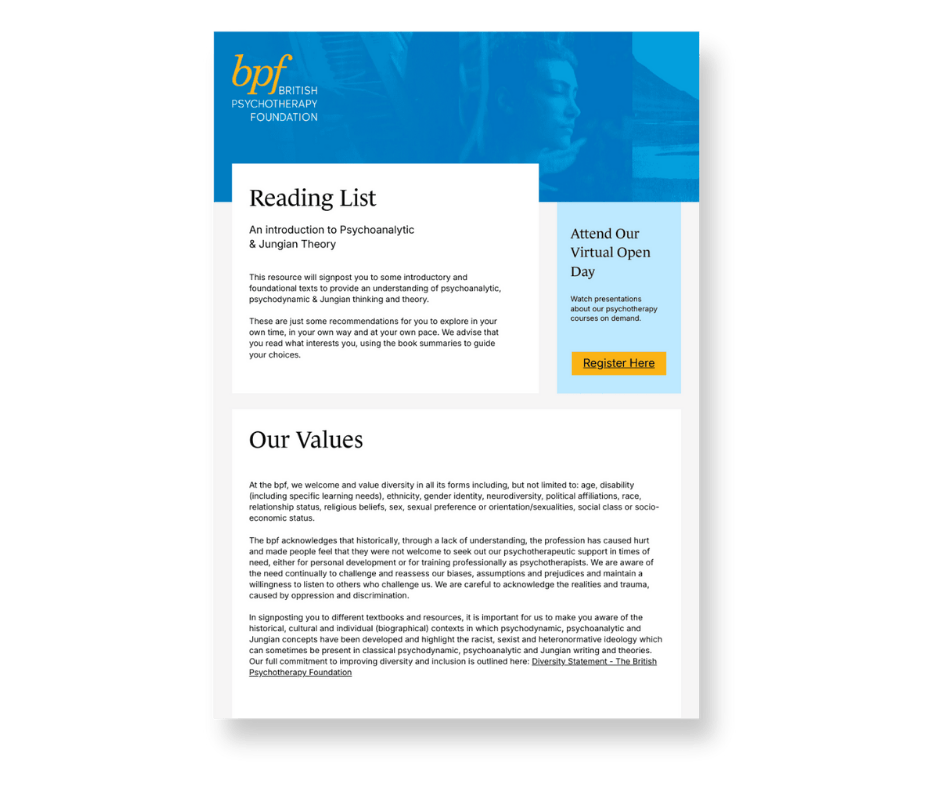
Download Free Reading List
This reading list highlights six key texts that offer an introduction to psychoanalytic, psychodynamic, and Jungian theory.
- Course Content
- Course Structure
- Entry Requirements
- Fees
- How to Apply
- Access information
This new year-long programme offers an opportunity to spend a substantial, and focused, period of time exploring the emergence of Freud’s thinking over some five decades: from his studies of hysteria in Paris and Vienna from the late 1880s, through to the later papers and essays in the 1920s and 1930s.
Study Routes
- You can apply to Freud: Advanced Studies as a Year One component of the Psychoanalytic Psychotherapy Training (PPA) with Adults. Subject to application, we will mentor you so that you can find the right experience and personal therapy to support your application, and will provide a home for you while you train.
- You can attend Freud: Advanced Studies as a standalone course that will support you in developing your engagement with one of the major authors of modern European thought. On completion of the course, attendees can claim a Certificate of Participation, which can be used as a first building block towards further training in psychoanalytic psychotherapy or, for those who have already qualified on a psychotherapy training, to fulfil CPD requirements.
- Trainees on other bpf programmes (e.g. the Foundation Course, Psychodynamic Psychotherapy, Couples Training) can apply to attend the course as an opportunity to extend and deepen their ongoing theoretical study.
Course Content
Alongside Freud’s groundbreaking case histories, texts and topics covered on Freud: Advanced Studies may include: hysteria and dreams; sexuality, symptom and trauma; the writings on the unconscious, the metapsychology and the second topography; the pleasure principle and its beyond; papers on mass psychology and civilisation; aggression and war (e.g. Studies on Hysteria (1893-95); The Interpretations of Dreams (1900); Three Essays on Sexuality (1905); ‘On Narcissism: An Introduction’ (1914); ‘Mourning and Melancholia’ (1917); ‘Thought for the Times on War and Death’ (1915); ‘Beyond the Pleasure Principle’ (1920), ‘Group Psychology and the Analysis of the Ego’ (1921); ‘Inhibition, symptom and anxiety’ (1926); ‘Fetishism’ (1927); ‘Instincts and their Vicissitudes’ (1915).
We will consider Freud’s writings in their own context – late 19th and early 20th century Vienna and the emergence of the psychoanalytic movement – but we will also attend to the relevance to our times. Writings by, for example, Adam Phillips, Darian Leader, Josh Cohen, Christopher Bollas, Jacqueline Rose, will be used to explore the significance of Freud’s psychoanalysis to our thinking about the conditions of being human through the 20th and into the 21st centuries.
The essential reading each week is designed to provide a shared point of departure for the seminar, and to support participants in the work of becoming independent readers of Freud. The emphasis will be on discussion and exploration throughout.
It is impossible to approach Freud’s writings without preconceptions, expectations, sometimes prejudices. Perhaps especially in the context of a psychoanalytic training, he is the ‘founding father’ of the discipline, a status that tends to amplify the pressure to understand and to find coherence in his writings: crudely, to know what Freud means and to make Freud make sense. But to read Freud, to interpret his writings – in the end, to use him in the consulting room or beyond – demands something else: something more like the free-floating, evenly hovering attention on which Freud would come to insist in his clinical practice. This programme attends to what happens when Freud embarks on his new clinical method of free association, and on the ideas he introduces to try to describe the experience, and significance, of that method. It is in that spirit that this course offers the opportunity to read, or reread, Freud.
Course Structure
All participants attend the weekly theory seminar, held on Tuesdays from 6.30–8.00pm at the bpf house, which forms the core of the course across its full length, from January to December.
- Participants on the clinical route into the PPA training additionally attend a weekly Work Discussion Group, held immediately after the seminar on Tuesdays from 8.15–9.45pm. This group explores how the ideas and theory covered in the seminars can be thought about in relation to participants’ own clinical or professional experience.
- Clinical route participants are also required to undertake an infant observation, which takes the form of an additional weekly seminar and can take place online. Students join an existing infant observation seminar group. The PPA requires a one-year infant observation, but attendance at the seminar group is often longer: it can take some time to identify a suitable family and infant to observe, the observation itself runs for one year, and a paper is submitted at the end of it. Taken together, attendance at the infant observation seminar may last up to two years or more.
Progression Routes
Participants who join Freud: Advanced Studies via the standalone certificate route may later wish to apply to the full Psychoanalytic Psychotherapy Training (PPA) , either while attending the course or on its completion. In such cases, participants will need to submit a formal application to the full training and complete the selection process in full.
Participants on either route are offered a tutor with whom they can meet once per term. Participants may discuss anything arising during the course with their tutor, including any wish to apply for further training.
A minimum of 80% attendance is required for completion.
Please note that completion of this year-long programme does not, on its own, guarantee entry onto the PPA’s clinical training. This applies to both routes: since a further interview is required to progress, satisfactory completion of the course is not sufficient by itself. Certificate-route participants who wish to apply to the full training will need to go through a separate application and selection process, and clinical-route (Year One) participants will need to attend the further interview described above before being confirmed for progression into Year Two.
Standalone Certificate Route
Freud: Advanced Studies is open to anyone with a serious interest in Freud’s writing, including graduates of the bpf Foundation Course and Psychodynamic Psychotherapy training, bpf trainees, qualified psychotherapists, and those from other academic backgrounds.
- Familiarity with psychoanalytic ideas.
- An academic qualification is common but not required, provided the applicant can demonstrate academic capability at postgraduate level in order to engage with complex material.
- There is no requirement to be in personal psychoanalytic psychotherapy to join on this route, although it is recommended, particularly for those considering a future career in the field.
Clinical Route (Year One of the PPA Training)
Those wishing to join Freud: Advanced Studies as Year One of the Psychoanalytic Psychotherapy Training (PPA) will need to meet the PPA’s entry requirements for the full training, which include:
- Familiarity with psychoanalytic ideas and relevant one-to-one experience supporting adults with emotional difficulties, whether professional or voluntary.
- Applicants without clinical or psychiatric experience will be required to complete a clinical placement and a separate psychiatric placement during training.
- Personal psychoanalytic psychotherapy with an approved PPA Training Therapist at a minimum frequency of three sessions per week.
- Applicants already in psychoanalytic psychotherapy at a lower frequency will be expected to increase their sessions to three times weekly during Year One.
- Where an applicant’s therapist is not currently on the approved list, the therapist would be expected to apply for approval.
- Applicants who are not yet in personal psychoanalytic psychotherapy should allow sufficient time to establish their therapy before applying to this route.
- An academic qualification is common but not required, provided the applicant can demonstrate academic capability at postgraduate level.
- Applicants must hold indefinite leave to remain (ILR) in the UK and be able to demonstrate sufficient spoken and written English to participate fully in the academic and clinical work.
Participants on the certificate route who later decide they wish to pursue the clinical route will need to meet these requirements in full as part of a separate application and selection process. Tutors are available to advise participants on how their current circumstances compare against these requirements, and what steps might be needed to strengthen a future application.
Please note that completion of this year-long programme does not, on its own, guarantee entry onto the PPA’s clinical training. This applies to both routes: since a further interview is required to progress, satisfactory completion of the course is not sufficient by itself. Certificate-route participants who wish to apply to the full training will need to go through a separate application and selection process, and clinical-route (Year One) participants will need to attend the further interview described above before being confirmed for progression into Year Two.
Fees
Course fees are subject to annual increase. The full year-long programme consists of three terms.
The tuition fee depends on your route: those on the clinical route pay the standard PPA Training fee (as charged for Year One of the PPA training), while those on the standalone certificate route pay a separate, certificate fee.
Certificate Route:
| Freud: Advanced Studies (Certificate Route) | Year 1 (3 terms; 10 seminars per term) | 2000* |
Clinical Route:
| (PPA) Psychoanalytic Psychotherapy | Year 1 (Freud: Advanced Studies) | 4488* |
| Years 2-4 | 4488* | |
| Year 5+ | 2193* |
An application fee of £75 applies to all applicants, on either route, and covers one interview.
Clinical-route participants who go on to apply for the remainder of the PPA full training at the end of this course will need to attend a further interview, for which an additional £75 interview fee applies.
Please note that completion of this year-long programme does not, on its own, guarantee entry onto the PPA’s clinical training. This applies to both routes: since a further interview is required to progress, satisfactory completion of the course is not sufficient by itself. Certificate-route participants who wish to apply to the full training will need to go through a separate application and selection process, and clinical-route (Year One) participants will need to attend the further interview described above before being confirmed for progression into Year Two.
On offer of a place, you will be invited to pay your fee via a secure payment link. This course is not eligible for instalment payment plans.
We are preparing our application process. If you are interested in attending the Freud: Advanced Studies certificate route only, please let us know by submitting an expression of interest below:
If you are interested in applying to our PPA training programme, and to join this course via the clinical route, please submit the questionnaire below:
If you have any questions about the course, please contact: [email protected]
Please note that the building has limited access – please email [email protected] to discuss your needs.
Apply to start in 2027
- Freud: Advanced Studies Taught in London from Sep 2027
- Certificate in Autism and Mental Health Online from Jan 2027
- Diploma in Psychodynamic Supervision Online from Mar 2027
- Summer School: Foundations of Psychoanalytic & Jungian Psychotherapy Online, Summer 2027
- Experiential Weekend: An Introduction to Psychoanalytic and Jungian Thinking In-person, November 2027
- Experiential Weekend: Deepening Analytic PracticeIn-person, October 2027
- Work Discussion: Understanding Children and Families from a Psychoanalytic Perspective Online, September 2027
- Psychiatry for Psychotherapists In-person, 2027
Upcoming Events
When Societies Lose Their Minds – Date: 14/10/2026 Time: 19:00 – 21:00 GMT, Online via Zoom. Lord John Alderdice, Dr Gwen Adshead and Professor Josh Cohen explore violence at both an individual and societal level. Click here to register.
Hierarchies and Fragmentations in Psychoanalysis: In-person Conference – 21 November 2026 | 10.00am – 5.00pm. Location: London (LIFT Islington). A conference exploring how psychoanalysis and Jungian analysis can evolve, adapt and thrive in the 21st century. Click here to register.

Make a £10 Donation – Receive a Psychoanalytic Reading List
Donating supports our mission to make our psychotherapy training, clinical services, and public events affordable, accessible, and more inclusive.
Reading List: Introduction to Psychoanalytic & Jungian Theory
Receive a curated list of 67 essential texts – covering psychoanalytic, psychodynamic, and Jungian theory – ideal for both newcomers and those wanting to deepen their knowledge.