Foundation Course – Psychotherapy & Counselling (London or Online)
Part-time study
Course length: 1 Year
The bpf’s Foundation Course is suitable for those at the beginning of their journey to become a qualified psychotherapist or counsellor. Built with flexibility in mind, this training is delivered through a combination of in-person and online teaching.
During this programme, trainees will gain an in-depth understanding of psychoanalytic and Jungian theory and have the opportunity to reflect critically upon the ways in which these ideas intersect with their personal experiences and the world at large. This course also offers a clinical module, where students will develop their clinical thinking and deepen their understanding of therapeutic practice.
While the bpf does not provide clinical placements as part of the Foundation Course, students who are considering progression to clinical training are strongly encouraged to secure a supervised clinical placement where possible. This enables them to make the best use of the clinical module, gain relevant experience, and prepare for further professional training.
The course aims to encourage critical thinking about human behaviour through a theoretical lens, facilitate opportunities for self-reflection, investigate differences in a creative and inclusive group setting, and support the development of each student’s unique identity as a practitioner.
Acceptance onto a subsequent clinical training is not guaranteed, and students must meet the specific entry requirements of the clinical training they wish to apply for. Personal tutors will support students in preparing for these requirements and considering their next steps in training.
Applications for October 2026 are now closed.
You can apply for October 2027 using the form below, but the October 2026 intake is now full.
This Foundation Course is the first year of our psychodynamic psychotherapy training.
Online open evening
Wednesday 9 September 2026, 7.00–8.15pm BST
Online via Zoom · Free
Meet course director Urvashi Chand, learn about the Foundation Course and its study options, and ask your questions.
For those based in the North of England/Scotland, we also run a Foundation Course in Newcastle upon Tyne. This is a different course with a tailored curriculum.
Resources
- Introduction
- Course Content
- FAQs
- Fees
- Course structure
- Entry Requirements
- Training Pathways
- Resources
- How to apply
Taking the first steps towards becoming a qualified psychotherapist can be daunting, and that is why we created a foundation course to provide trainees with all of the support, guidance, theory and experience they need at the very start of their journey.
- Students will learn from experienced psychoanalytic psychotherapy clinicians, academics and researchers, and be taught to the bpf’s rigorous clinical and academic standards. Each trainee will also be provided with a tutor who will support them with their studies and offer further career guidance.
- In addition to receiving world-class teaching, this part-time Foundation Course offers unparalleled flexibility and is easily accessible to those already in full time employment, as well as those who live outside of London. This course is taught across 10 Saturday study days (which can be attended online or in person) and fortnightly online seminars, on a weekday evening.
- This course is uniquely positioned among psychotherapy foundation trainings in that it includes a clinical module in which clinical material is discussed. Students are strongly encouraged to secure a supervised clinical placement so they can make the most of this module and prepare for further clinical training.
- Through the clinical module, students develop their understanding of therapeutic work, begin to formulate their professional identities as practitioners, and explore the nature of the therapeutic relationship. The taught component introduces students to the development of an analytic attitude and encourages reflection on clinical experience within a psychoanalytic framework.
The bpf does not provide clinical placements as part of the programme. However, we are able to share information about organisations where previous students have successfully secured placements, and we can provide a letter confirming a student’s attendance on the course to support their placement applications.
Please note: if you have already completed ‘Psychotherapy Today’ as a standalone introductory theory course, then you can study just the Clinical Module from our Foundation Course as a standalone module, in order to then be eligible for one of our qualifying courses.
If this applies to you, please contact [email protected]
This year-long Foundation Course is a pre-clinical course. To work as an accredited psychotherapist in the UK, students will need to complete a subsequent clinical/qualifying training, which typically last 3 years or longer.
Graduates of this course should have all of the theoretical and voluntary/work experience needed to apply for the bpf’s clinical/qualifying courses, or other clinical trainings in psychodynamic, Jungian and psychoanalytic practice taught elsewhere.
Acceptance onto a subsequent clinical training is not guaranteed, and students will need to meet the specific entry requirements for the clinical training they wish to apply to. Personal tutors will help students to prepare for these entry requirements.
The theory module syllabus has been designed to facilitate reflection on the ways in which psychoanalytic and Jungian thinking can be applied to both one’s personal experience as well as political and social issues. You will examine questions ranging from ‘What is a mind?’ and ‘How do we become who we are?’ to thinking about issues like group dynamics, racism and homophobia.
In the clinical module, students will gain essential practical experience and start formulating their identities as practitioners. The taught component of the clinical module will also teach students about the nature of the therapeutic relationship and how to develop an analytic attitude.
How flexible is this course?
This course is taught across 10 Saturday study days (which can be attended online or in person) and fortnightly online seminars, on a weekday evening. This structure makes studying alongside full-time work possible.
If you are already gaining relevant clinical experience at work, or voluntarily, you may not be required to find another placement during your studies.
If you have any questions about anything mentioned above, please email: [email protected]
What happens if I have already completed the Psychotherapy Today course?
Students that have completed, or are currently studying, our Psychotherapy Today course will only need to take the clinical module on the Foundation Course to complete the programme. A reduced course fee will be available in such circumstances.
To find out more before applying, please email: [email protected]
Who is teaching?
All seminar leaders, discussion facilitators and mentors are bpf psychoanalytic psychotherapists, Jungian analysts, child and adolescent psychotherapists or psychoanalysts working in private practice, the voluntary sector and the NHS. All course members are skilled and experienced in managing and facilitating thinking and feelings in a group and individual context.
What other learning opportunities are out there?
The bpf offers infant observation groups, reading groups and advice on personal training analysis if you wish to develop your learning further. These may be taken in conjunction with the Foundation Course, particularly if you are looking to apply for qualifying training. On the course you will be assigned a personal tutor, who will be able to advise you on pathways to training.
Fees
Please note that fees will be subject to annual increases in line with inflation in the UK.
| Foundation Course (London) | Full Course: Year 1 (3 terms) | 5375* |
| Clinical Course ONLY | 3738* | |
| Theory Course ONLY | 2748* | |
| Child Development Module | 734* | |
| Clinical ONLY (MSc Students) | 2433* |
In order to apply, applicants are required to pay a non-refundable application fee of £25 at the point of submission. On offer of a place, you will be invited to pay a non-refundable deposit, which will be deducted from the course fee.
Please contact [email protected] to find out more.
Please note that the bpf will not be held responsible for travel/hotel expenses made or incurred in the unlikely event of this course either being cancelled or postponed.
Whilst studying, Foundation Course students must hold a bpf Student Membership, which is included in the course fees. For more information, view course fees.
This course is comprised of a theory module and a clinical module. The content will be delivered through seminars, discussion groups, and a clinical placement.
Theory module
The Theory module consists of seminars that take place on Saturday study days, once per month (choose online or in-person attendance).
On each Saturday study day, two seminars are delivered on a specific theme; one seminar offers a psychoanalytic perspective, the other a Jungian perspective. In the initial seminars, you will be introduced to a range of theories and models of mind, starting with Freud and Jung all the way through to the present day. The rest of the seminars will take a more applied approach, exploring how ‘Psychotherapy’ can be thought about and practiced ‘Today’.
Each Saturday study day is finished with an experiential group, which is an excellent way to learn about and experience unconscious processes and group dynamics.
Clinical Module
The clinical module will include a clinical placement, secured by the student, as well as taught clinical seminars and discussion groups. In the first half of taught seminars, students will learn about:
- Setting up a therapeutic frame
- The core components of the therapeutic relationship
- Transference and counter-transference
- Holding an analytic attitude
In the second half of these seminars, a work discussion group will take place where students will have the opportunity to reflect upon their experiences during placement in a supportive setting.
Foundation Course 2026–2027
Saturday Dates
Autumn Term
- 17 October 2026 – Day 1 (Online) / 24 October 2026 (In-Person)
- 21 November 2026 – Day 2
- 12 December 2026 – Day 3
Spring Term
- 9 January 2027 – Day 4
- 13 February 2027 – Day 5
- 13 March 2027 – Day 6
Summer Term
- 24 April 2027 – Day 7
- 15 May 2027 – Day 8
- 19 June 2027 – Day 9
- 17 July 2027 – Day 10
Clinical Seminar Dates
Monday Group
Autumn Term
Half Term: Monday 26 October – Friday 30 October 2026
Monday 19 October 2026
Monday 2 November 2026
Monday 16 November 2026
Monday 30 November 2026
Monday 14 December 2026
Spring Term
Half Term: Monday 15 February – Friday 19 February 2027
Monday 18 January 2027
Monday 1 February 2027
Monday 22 February 2027
Monday 8 March 2027
Monday 22 March 2027
Summer Term
Half Term: Monday 31 May – Friday 4 June 2027
Monday 19 April 2027
Monday 10 May 2027
Monday 24 May 2027
Monday 7 June 2027
Monday 21 June 2027
Thursday Group
Autumn Term
Half Term: Monday 26 October – Friday 30 October 2026
Thursday 22 October 2026
Thursday 5 November 2026
Thursday 19 November 2026
Thursday 3 December 2026
Thursday 17 December 2026
Spring Term
Half Term: Monday 15 February – Friday 19 February 2027
Thursday 21 January 2027
Thursday 4 February 2027
Thursday 25 February 2027
Thursday 11 March 2027
Thursday 25 March 2027
Summer Term
Half Term: Monday 31 May – Friday 4 June 2027
Thursday 22 April 2027
Thursday 13 May 2027
Thursday 27 May 2027
Thursday 10 June 2027
Thursday 24 June 2027
Friday Group
Autumn Term
Half Term: Monday 26 October – Friday 30 October 2026
Friday 23 October 2026
Friday 6 November 2026
Friday 20 November 2026
Friday 4 December 2026
Friday 18 December 2026
Spring Term
Half Term: Monday 15 February – Friday 19 February 2027
Friday 22 January 2027
Friday 5 February 2027
Friday 26 February 2027
Friday 12 March 2027
Friday 26 March 2027
Summer Term
Half Term: Monday 31 May – Friday 4 June 2027
Friday 23 April 2027
Friday 14 May 2027
Friday 28 May 2027
Friday 11 June 2027
Friday 25 June 2027
Please note: The clinical course can only be taken on either a Monday, Tuesday or Thursday, every fortnight.
Tutorials
Students will be allocated a tutor to support them during their studies. Tutors will also help to prepare students with their applications for further study.
Other course components
You will be provided with suggested reading and watching lists and can immerse yourself as deeply as you wish.
Please note: if you have already completed the Theory Module as a standalone course, then you can study just the Clinical Module from our Foundation Course as a standalone module, in order to then be eligible for one of our qualifying courses.
If this applies to you, please contact [email protected]
This course will be of interest to those looking to take their first steps towards becoming a qualified psychotherapist.
The course is open to all sections of society and encourages applications from a diverse range of people. You may already be working in the caring professions (such as a GP, Social Worker or Nursery Nurse) or you might come from a completely different background.
Life experience is strongly valued. Just bring your curiosity, openness and an interest in exploring new ways of looking at the self and the world. Although not a requirement we highly recommend that students are in therapy to help support you on the course. Learning of this nature can stir up unexpected feelings and it is really helpful to have a place to work these through. Being in therapy is a requirement for entry onto further qualifying training.
If you have any questions about this, please email: [email protected]
If you would like more information on accessing therapy with a bpf member please click here.
See our Psychotherapy Training Pathways diagram to view the potential pathways to qualification as a psychotherapist or analyst. Acceptance onto a subsequent clinical training is not guaranteed, and students will need to meet the specific entry requirements for the clinical training they wish to apply to. Personal tutors will help students to prepare for these entry requirements.
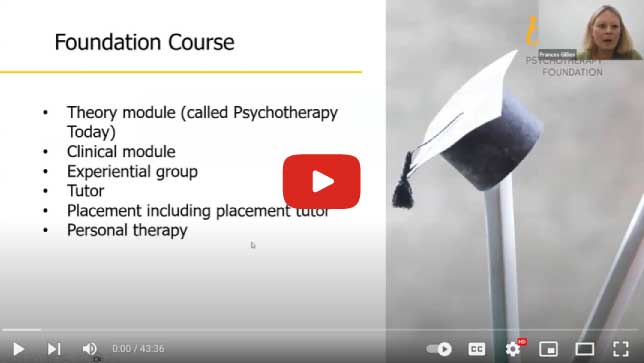
Attend our Virtual Open Day to watch a presentation about this course.
Blogs
Frequently Asked Questions About Psychodynamic Psychotherapy
How to become a psychotherapist in the UK – The British Psychotherapy Foundation
My Journey as a Black Trainee in Psychodynamic Psychotherapy – The British Psychotherapy Foundation
How Couples Psychotherapy Can Transform Relationships – The British Psychotherapy Foundation
Why become a psychotherapist? (part I)
Why become a psychotherapist? (part II)
Videos
What’s it like to be a psychotherapist? Psychoanalytic psychotherapist (youtube.com)
What’s it like to be a psychotherapist? Child and Adolescent Psychotherapist (youtube.com)
What’s it like to be a psychotherapist? Jungian Analyst (youtube.com)
Applications for October 2026 are now open.
To apply for this course, please click the ‘Apply Now’ button above.
The application fee for this course is £25, and this will need to be paid before your application can be considered.
Places for this course are offered on a first come first served basis. We recommend applying early to avoid disappointment.
The standard of teaching was exceptional, and the course structure fostered an environment conducive to our growth and development as clinicians. Regular weekly supervision sessions allowed us to strengthen our peer relationships while deepening our learning.
bpf Student
Simply, it exceeded all my expectations, and sufficiently impressed and enthused me to consider a future career in psychotherapy. On a personal level it has changed me; something that has been accelerated by beginning my own personal analysis. I find myself thinking about non-verbal communications much more as a consequence of having attended the course.”
bpf Student
The course has allowed me to dip my toe into the analytic world and provided a broad overview of the analytic landscape. It has enhanced my understanding of psychoanalytic ideas and I’ve particularly benefited from speaking to experienced clinicians. The discussion groups in particular have been useful to clarify my own ideas and get a different perspective from others. Overall, it has helped me to determine if I would like to pursue work in this field.”
bpf Student
Apply to start in 2027
- Freud: Advanced Studies Taught in London from Sep 2027
- Certificate in Autism and Mental Health Online from Jan 2027
- Diploma in Psychodynamic Supervision Online from Mar 2027
- Summer School: Foundations of Psychoanalytic & Jungian Psychotherapy Online, Summer 2027
- Experiential Weekend: An Introduction to Psychoanalytic and Jungian Thinking In-person, November 2027
- Experiential Weekend: Deepening Analytic PracticeIn-person, October 2027
- Work Discussion: Understanding Children and Families from a Psychoanalytic Perspective Online, September 2027
- Psychiatry for Psychotherapists In-person, 2027
Upcoming Events
When Societies Lose Their Minds – Date: 14/10/2026 Time: 19:00 – 21:00 GMT, Online via Zoom. Lord John Alderdice, Dr Gwen Adshead and Professor Josh Cohen explore violence at both an individual and societal level. Click here to register.
Hierarchies and Fragmentations in Psychoanalysis: In-person Conference – 21 November 2026 | 10.00am – 5.00pm. Location: London (LIFT Islington). A conference exploring how psychoanalysis and Jungian analysis can evolve, adapt and thrive in the 21st century. Click here to register.

Make a £10 Donation – Receive a Psychoanalytic Reading List
Donating supports our mission to make our psychotherapy training, clinical services, and public events affordable, accessible, and more inclusive.
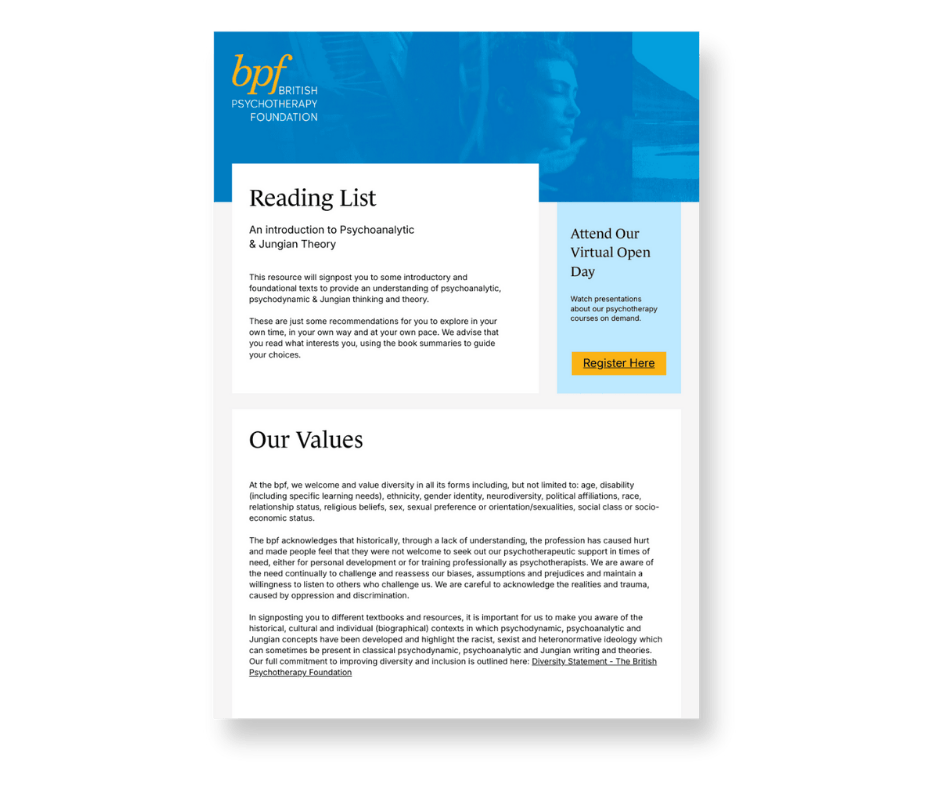
Reading List: Introduction to Psychoanalytic & Jungian Theory
Receive a curated list of 67 essential texts – covering psychoanalytic, psychodynamic, and Jungian theory – ideal for both newcomers and those wanting to deepen their knowledge.