Certificate in Autism and Mental Health
Online
Training Location: Online. 6 months (one Saturday per month).
This certificate course in Autism and Mental Health: understand, assess and work with children with autism and their families, is designed for qualified counsellors, psychotherapists, applied psychologists, trainee child psychotherapists, and others with relevant experience of working with children and young people with autism.
The programme draws on psychoanalytic, psychodynamic, psychosocial, psychoeducational, and psychological perspectives. It enables students to critically engage with current research, developments in clinical and psychoeducational practice, early intervention approaches, assessment methods, and policy relating to autism.
The course also supports a deeper understanding of special and inclusive education, with a particular focus on autism and the needs of autistic children and young people.
Applications for January 2027 are now open.
Deadline for applications: Friday, 6 November 2026.
Join us for a webinar with Arianna Pulsoni
Thursday, 3 December 2027 at 7pm
- Course Content
- Course Structure
- Entry Requirements
- Fees
- How to Apply
- Resources
Course Content
The programme will explore autism and mental health in the current context from a theoretical and clinical perspective. It prioritises contemporary psychoanalytic, psychodynamic theories, whilst also drawing on research findings and relevant ideas from other disciplines. Some relevant topics will be also explored, like development, identity, eating, sleeping, behaviour, language and communication and play.
- In the first term, participants will be encouraged also to think about their current therapeutic work, to apply the theories to practice and to think further on ways of working with children with autism and their families.
- In the second term, the main focus is mostly on clinical practice. Participants will learn about clinical assessment, online clinical assessment, and some early, video and group interventions working with young children with autism.
Key Themes (dates to be confirmed)
Study day 1 (Jan 2027) – Understand autism and its impact on young children and families. Research and Practice.
Study day 2 (Feb 2027) – Early Signs of autism in babies and toddlers: The role of the body in children with autism.
Study Day 3 (Mar 2027) – Clinical assessment: assessing young children with autism remotely and in person.
Study Day 4 (Apr 2027) – An Early Intervention framework for young children with autism/autistic traits and their families. Foster skills for creating inclusive therapeutic environments: working with families, schools and other professionals.
Study Day 5 (May 2027) – Tiny Bloom: an early intervention to work with parents and babies and young toddlers with autism or autistic traits.
Study Day 6 (Jun 2027) – School based interventions to support children with autism.
Course Facilitator
Arianna Pulsoni
Arianna is a qualified Child and Adolescent Psychoanalytic Psychotherapist and has extensive experience with families, children and adolescents, clinical supervision, teaching, and research. She is also a lecturer, in the Department of Psychosocial and Psychoanalytic studies at the University of Essex, where she is module supervisor on undergraduate, postgraduate and professional doctoral modules, and a PhD and Professional Doctorate supervisor and examiner. She is the Course Director for the clinical training and MA in Psychodynamic Counselling and Psychotherapy at the University of Essex, and the course coordinator and senior supervisor of Infant Observation at the Association for Group and Individual Psychotherapy (AGIP).
Arianna is the therapeutic lead of Transforming Autism, where she provides leadership to the charity’s programmes and early interventions and she contributes to the design and development of clinical and non-clinical programmes and early interventions for babies and young children.
Course Structure
The course is held entirely online, between 10am and 3pm, and will take place one Saturday a month, for 6 months (January – July).
The mornings will consist of one theory seminar and one workshop led by senior child psychotherapist. You will learn from a diverse group of senior clinicians and thinkers, who are experts in their subject areas. Each seminar leader will teach their seminar in their own way and style, but as a minimum, they will:
- Explain and develop the theme to be discussed in the seminar, including its theoretical framework.
- Include recent developments (including research), thinking and controversies in the subject area.
- Provide several clinical examples from their own practice or clinical vignettes to bring the theme to life.
In discussion groups, your seminar leaders will:
- Promote respectful discussion.
- Allow space for each of you to think about how subject matters introduced that day can be applied to your own current practice.
- Encourage questions, debate, critical thinking and allow challenge.
- Encourage co-operative learning and minimise competitiveness.
The intention is to encourage creativity, curiosity, and the exchange of ideas and approaches, enabling participants to gain the greatest benefit from their learning and development.
For those who wish to participate, peer supervision groups will be arranged to provide an opportunity to discuss course material, reflect on its clinical application, and learn collaboratively with colleagues.
Indicative timetable:
- 10:00-11:00am – Theory Seminar (ALL students attend)
- 11:00-11:15am – Break
- 11:15am-12:15pm – Workshop (ALL students attend)
- 12:15-12:45pm – Break
- 12:45-14:00pm – Guest Speaker
- 14:00-14:15pm – Break
- 14:15-15:30pm – Clinical Case Discussion
- End for most of the students who do not attend clinical seminar in summer or peer supervision group through the year.
- 15:30-15:45 break for students who are undertaking either the clinical seminar or peer supervision group.
Entry Requirements
This certificate course is designed for qualified counsellors, psychotherapists, applied psychologists, trainee child psychotherapists, and others with relevant experience of working with children and young people with autism.
Places will be allocated according to applicants’ experience, professional background and relevant previous qualifications.
Successful completion of the course leads to a certificate of attendance. A minimum of 80% attendance is required for completion, alongside engagement and participation during sessions.
The course is delivered at postgraduate level in English.
Fees
| Autism and Mental Health | Standard (6 study days) | 1950* |
Please note that fees will be subject to annual increases in line with inflation in the UK.
There is a non-refundable application fee of £75. The application process involves submitting an application form and attending a brief online. interview.
On offer of a place, you will be invited to register and pay the fees through a secure payment link. A place will only be secured once the fee has been paid.
Apply for this course below:
Deadline for applications: Friday, 6 November 2026.
Join us for a webinar with Arianna Pulsoni on Thursday, 3 December 2027 at 7pm:
To find out more about this course, please contact us at [email protected].
Blogs
Frequently Asked Questions About Psychodynamic Psychotherapy
How to become a psychotherapist in the UK – The British Psychotherapy Foundation
My Journey as a Black Trainee in Psychodynamic Psychotherapy – The British Psychotherapy Foundation
How Couples Psychotherapy Can Transform Relationships – The British Psychotherapy Foundation
Why become a psychotherapist? (part I)
Why become a psychotherapist? (part II)
Videos
What’s it like to be a psychotherapist? Psychoanalytic psychotherapist (youtube.com)
What’s it like to be a psychotherapist? Child and Adolescent Psychotherapist (youtube.com)
What’s it like to be a psychotherapist? Jungian Analyst (youtube.com)
The standard of teaching was exceptional, and the course structure fostered an environment conducive to our growth and development as clinicians. Regular weekly supervision sessions allowed us to strengthen our peer relationships while deepening our learning.
bpf Student
Simply, it exceeded all my expectations, and sufficiently impressed and enthused me to consider a future career in psychotherapy. On a personal level it has changed me; something that has been accelerated by beginning my own personal analysis. I find myself thinking about non-verbal communications much more as a consequence of having attended the course.”
bpf Student
The course has allowed me to dip my toe into the analytic world and provided a broad overview of the analytic landscape. It has enhanced my understanding of psychoanalytic ideas and I’ve particularly benefited from speaking to experienced clinicians. The discussion groups in particular have been useful to clarify my own ideas and get a different perspective from others. Overall, it has helped me to determine if I would like to pursue work in this field.”
bpf Student
Apply to start in 2027
- Freud: Advanced Studies Taught in London from Sep 2027
- Certificate in Autism and Mental Health Online from Jan 2027
- Diploma in Psychodynamic Supervision Online from Mar 2027
- Summer School: Foundations of Psychoanalytic & Jungian Psychotherapy Online, Summer 2027
- Experiential Weekend: An Introduction to Psychoanalytic and Jungian Thinking In-person, November 2027
- Experiential Weekend: Deepening Analytic PracticeIn-person, October 2027
- Work Discussion: Understanding Children and Families from a Psychoanalytic Perspective Online, September 2027
- Psychiatry for Psychotherapists In-person, 2027
Upcoming Events
When Societies Lose Their Minds – Date: 14/10/2026 Time: 19:00 – 21:00 GMT, Online via Zoom. Lord John Alderdice, Dr Gwen Adshead and Professor Josh Cohen explore violence at both an individual and societal level. Click here to register.
Hierarchies and Fragmentations in Psychoanalysis: In-person Conference – 21 November 2026 | 10.00am – 5.00pm. Location: London (LIFT Islington). A conference exploring how psychoanalysis and Jungian analysis can evolve, adapt and thrive in the 21st century. Click here to register.

Make a £10 Donation – Receive a Psychoanalytic Reading List
Donating supports our mission to make our psychotherapy training, clinical services, and public events affordable, accessible, and more inclusive.
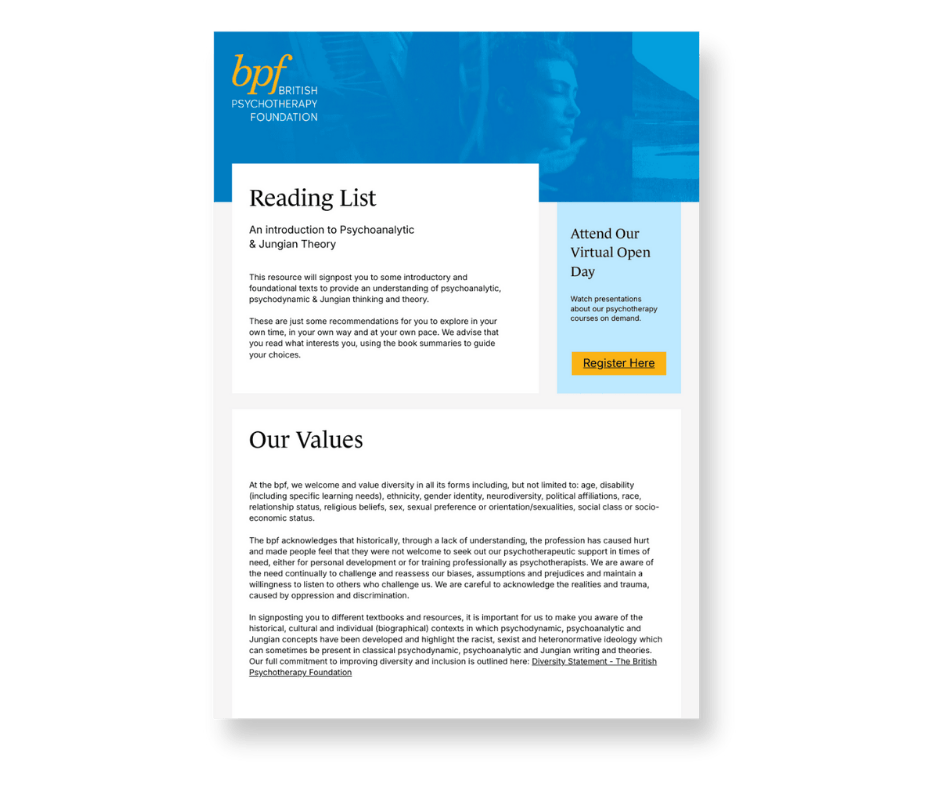
Reading List: Introduction to Psychoanalytic & Jungian Theory
Receive a curated list of 67 essential texts – covering psychoanalytic, psychodynamic, and Jungian theory – ideal for both newcomers and those wanting to deepen their knowledge.