Hierarchies and Fragmentations in Psychoanalysis
The bpf and CPJA are collaborating on an innovative project designed to promote open, ongoing discussions about psychoanalysis and Jungian psychotherapy in the 21st century.
An Online Event Series + Conference
The British Psychotherapy Foundation (bpf), UK Council for Psychotherapy and the Council for Psychoanalysis and Jungian Analysis (CPJA) are collaborating on an innovative project designed to promote open, ongoing discussions about psychoanalysis and Jungian psychotherapy in the 21st century. This project focuses on addressing professional and institutional challenges that have previously contributed to hierarchy, rivalry and division within the field.
The project features three online workshops followed by an in-person conference. The online workshops, held prior to the conference, will highlight key debates and set the stage for deeper conversation. Ideas and themes from these workshops will be examined further during the conference.
Each online workshop, led by a distinguished academic or expert, will be 2 hours long. The structure of each online workshop will be as follows:
- 19:30 – 19.40: Dr Frances Gillies (bpf CEO) and Gwion Jones (Chair of CPJA) welcome attendees, provide background on project and its aims, and welcome the speaker.
- 19:40 – 20:30: Speaker outlines workshop themes.
- 20:30 – 21:00: Breakout groups.
- 21:00 – 21:30: Group discussion.
Recordings of the workshops will be analysed to identify central themes, which will be used to shape the conference’s programme and ensure the continuation of in-depth discussions about how we might resolve divisions and rifts within the profession. Workshop attendees will also be given the opportunity to lead talks at the conference.
The project aims to unite analytic scholars, clinicians, researchers, and organisations. By creating a space where differences are valued and explored, the project seeks to foster curiosity and appreciation for varied professional perspectives.
Who should attend online workshops and conference:
Qualified analytic practitioners (psychodynamic, psychoanalytic, Jungian, Lacanian etc.), trainees and educators on analytic trainings.
Events in the series:
Online Workshop 1
Is there a standard analytic model in psychoanalysis and Jungian psychotherapy?
When: Thursday 23rd April 2026
Time: 19.30 – 21.30
Schedule:
- 19:30 – 19.40: Dr Frances Gillies (bpf CEO) and Gwion Jones (Chair of CPJA) welcome attendees, provide background on project and its aims, and welcome the speaker.
- 19:40 – 20:30: Speaker outlines workshop themes.
- 20:30 – 21:00: Breakout groups.
- 21:00 – 21:30: Group discussion.
Facilitator: Sue Kegerreis is a Professor in the Department of Psychosocial and Psychoanalytic Studies at the University of Essex where she set up and is Course Director of the MA in Psychodynamic Counselling and Psychotherapy. Before this she introduced and ran the MSc in Psychodynamic Counselling with Children and Adolescents at Birkbeck. Trained initially at the Tavistock and then at the Lincoln (now the British Psychotherapy Foundation), she has worked with children, adolescents and adults in CAMHS, hospital and school settings as well as privately. She has taught on a range of courses and published widely on clinical, training and societal issues. Sue is particularly engaged in promoting research among psychodynamic practitioners and re-launched the Professional Doctorate for counsellors and psychotherapists at the University of Essex. She is Managing Editor of Psychodynamic Practice.
Ticket cost:
- £25 (Standard)
- £15 (Concession for students and retired individuals)
Maximum attendees: 80
This workshop will explore whether a standard model exists in psychoanalytic practice. Traditional approaches, like the use of the couch and frequent sessions, are often seen as defining features, yet clinicians admit to using more flexible methods. The boundaries between psychoanalysis, psychoanalytic psychotherapy, and psychodynamic counselling are increasingly blurred – are such strict distinctions necessary? The session will consider whether psychoanalysis needs a standard model or would benefit from a more adaptive, pluralistic approach, and how might strict adherence to tradition limit responsiveness to individual client needs, evolving social contexts and diverse client presentations?
Online Workshop 2
Can theoretical divisions in psychoanalysis and Jungian psychotherapy be divorced from institutional hierarchies?
When: Thursday 14th May 2026
Times: 19.30 – 21.30
Schedule:
- 19:30 – 19.40: Dr Frances Gillies (bpf CEO) and Gwion Jones (Chair of CPJA) welcome attendees, provide background on project and its aims, and welcome the speaker.
- 19:40 – 20:30: Speaker outlines workshop themes.
- 20:30 – 21:00: Breakout groups.
- 21:00 – 21:30: Group discussion.
Facilitator: Jean Knox is Associate Professor at the University of Exeter and Academic Director for the:
- Doctorate of Clinical Practice (Research)
- Doctorate of Psychoanalytic and Psychodynamic Psychotherapy Clinical Practice
- Professional Qualifying Training in Psychodynamic and Psychoanalytic Psychotherapy.
She is Chair of the Trustees of the British Psychotherapy Foundation and the bpf representative on the British Psychoanalytic Council. She has been Editor-in -Chief of the Journal of Analytical Psychology.
She has been a training therapist and supervisor for the Society of Analytical Psychology, the British Psychotherapy Foundation, Severnside, West Midlands Institute and AGIP trainings and a member and supervisor for BAPPS (British Association for psychoanalytic and psychodynamic supervision). She is an honorary member of the International Attachment Network
She has taught and lectured for numerous national and international psychoanalytic and Jungian training institutes, as well as the Tavistock Trauma Centre, the Bowlby Centre, the International Attachment Network, Confer and others. She has researched, written and taught extensively on the relevance of research in attachment theory and developmental neuroscience to psychotherapy theory and practice.
Ticket costs:
- £25 (Standard)
- £15 (Concession for students and retired individuals)
Maximum attendees: 80
This session explores the ways in which competing theoretical frameworks, such as Freudian, Jungian, Kleinian, and other psychoanalytic schools, have profoundly influenced the institutional structure and culture of psychoanalysis. These historical divisions have not only influenced the development of training programmes and professional standards but have also contributed to the formation of distinct professional identifies within the field. The session will consider how these theoretical divisions have shaped the culture of training institutions, often leading to rigid hierarchies, a ‘bunker mentality’, and divisive attitudes that can sometimes hinder collaboration and innovation. How might more partnership and openness be facilitated?
Online Workshop 3
Can psychoanalysis and Jungian psychotherapy evolve to respond to contemporary life?
When: Thursday 2nd July 2026
Times: 19.30 – 21.30
- 19:30 – 19.40: Dr Frances Gillies (bpf CEO) and Gwion Jones (Chair of CPJA) welcome attendees, provide background on project and its aims, and welcome the speaker.
- 19:40 – 20:30: Speaker outlines workshop themes.
- 20:30 – 21:00: Breakout groups.
- 21:00 – 21:30: Group discussion.
Speakers: George Taxidis (he/him) (Goldsmiths, University of London)
Ticket costs:
- £25 (Standard)
- £15 (Concession for students and retired individuals)
Maximum attendees: 80
The emergence and resurgence of hateful rhetoric – particularly misogynistic, racist, anti-migrant and anti-trans hate – is creeping into state and institutional policies, threatening the lives and wellbeing of millions. In this context, this session will explore the ways in which the hierarchies in our profession are often reflecting and even reinforcing inequalities and injustices in the wider world. What might intersectional queer, feminist and decolonial thinking have to offer contemporary psychoanalysis and Jungian analysis? What kinds of defences does psychoanalysis itself employ against learning and adapting to the 21st century? What might depth psychology have to offer those who long for a more just world?
In-person conference
Is psychoanalysis and Jungian psychotherapy fit for purpose in the 21st century?
When: Saturday 12th September 2026
Time: 11.00am to 4.00pm
Where: The Blue Hall, Lift Inslington, 45 White Lion Street, Islington, NW1 9PW
Maximum capacity: 100 delegates
Ticket Costs: £65
Speakers: Leading academics and experts (tbc)
The specific details of the conference programme will be confirmed once the themes from the online workshops have been identified. The broad aim of the conference will be to build on the online discussions of how psychoanalysis and Jungian psychotherapy can respond to their own internal fragmentations and divisions, across training models, theoretical schools, clinical approaches and institutional cultures.
The programme will likely explore how psychoanalysis and Jungian psychotherapy can maintain their traditional principles while adapting to modern demands such as technology innovation, evidence-based practice, and cultural sensitivity. Key topics and debates will include the future of training, diversity and inclusion within the field, institutional hierarchies and politics, relationships with other mental health disciplines, the impact of technological innovation, and the pressures of regulation and standardisation. The programme aims to fosters dialogue and facilitate reflection on whether psychoanalysis and Jungian psychotherapy remain ‘fit for purpose’ in contemporary society or are losing their unique identity.
There will be keynote lectures with high profile practitioners and academics setting the stage for a day of critical reflection and creative engagement, as well as discussion groups and audience participation.
Registration for the conference will open in March.
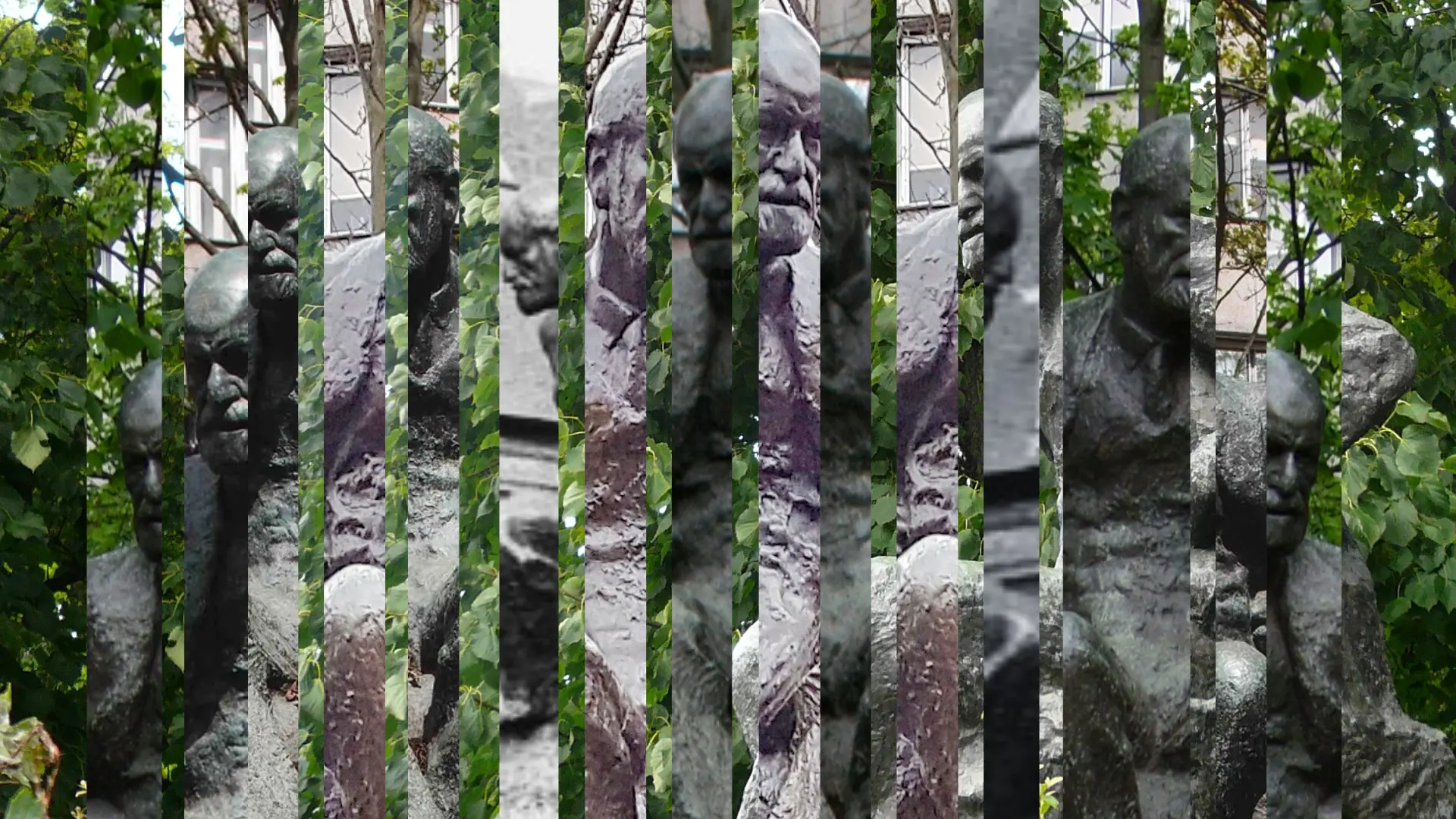
Image(s) Copyright.
Our event image combines fragmented sections of the following images:
- Freud Tavistock.jpg – photographed by Sara Richards on 27 March 2007 (Flickr upload). Licensed under the Creative Commons Attribution‑Share Alike 2.0 Generic (CC BY‑SA 2.0) license.
- Sigmund Freud in Hampstead – geograph.org.uk – 485705.jpg – taken on 4 July 2007 by ceridwen for the Geograph project. Copyright owned by the photographer and available under CC BY‑SA 2.0; credit as “ceridwen – Sigmund Freud in Hampstead”.
- Sigmund Freud statue – 2025‑10‑24.jpg – image taken on 24 Oct 2025 by Matt Brown (Flickr user “Matt From London”). Released under the Creative Commons Attribution 4.0 International license (CC BY 4.0).
- Sigmund Freud statue, Hampstead.jpg – own photograph by JRennocks, taken 16 Feb 2019 in Hampstead. Available under the Creative Commons Attribution 4.0 International license.
- Sigmund Freud statue, London 1.jpg – photograph by Mike Peel (mikepeel.net) shot on 25 April 2010. It is licensed under the Creative Commons Attribution‑Share Alike 4.0 International (CC BY‑SA 4.0) license; attribute as “Photograph by Mike Peel”.
- Sigmund Freud statue, London 2 (cropped).jpg – cropped version of Mike Peel’s 25 Apr 2010 photo. Also released under CC BY‑SA 4.0; credit “Photograph by Mike Peel”.
- Sigmund Freud statue, London 2.jpg – original version of the above, photographed by Mike Peel on 25 Apr 2010 and licensed under CC BY‑SA 4.0.
- Sigmund Freud statue, London.jpg – another view taken by Mike Peel on 25 Apr 2010. Available under CC BY‑SA 4.0; credit “Photograph by Mike Peel”.
- Sigmund Freud statue, South Hampstead – geograph.org.uk – 4933039.jpg – Geograph photo taken 29 Apr 2016 by Jim Osley. The image is under CC BY‑SA 2.0; attribute as “Sigmund Freud statue, South Hampstead by Jim Osley”.
- Sigmund Freud statue, South Hampstead – geograph.org.uk – 4933055.jpg – another view from 29 Apr 2016 by Jim Osley (Geograph). Licensed under CC BY‑SA 2.0; credit as above.
- Statue of Sigmund Freud – geograph.org.uk – 1106151.jpg – photographed 17 Dec 2008 by Mike Quinn for Geograph. Reuse permitted under CC BY‑SA 2.0.
- Statue of Sigmund Freud – geograph.org.uk – 2327196.jpg – Geograph photo taken 27 Mar 2011 by Robin Webster. Available under CC BY‑SA 2.0; credit “Statue of Sigmund Freud by Robin Webster”.
- Statue of Sigmund Freud, Hampstead.jpg – own work by Stanislav Kozlovskiy photographed 9 Aug 2014. Licensed under CC BY‑SA 4.0.
- Tavistock and Freud statue – cropped.jpg – photo of the statue with Tavistock Clinic behind, taken 8 May 2009 by Iridescenti and cropped by Rav. Dual‑licensed: the GNU Free Documentation License 1.2 or later and Creative Commons Attribution‑Share Alike versions 3.0/2.5/2.0/1.0; you may reuse it under any of those licenses.
- Tavistock and Freud statue.JPG – original photograph of the statue at Tavistock Clinic by Iridescenti on 9 May 2007. Because the statue is in a public place in the UK, the photo is exempt from copyright restrictions, but the photographer additionally releases it under the GFDL 1.2 or later and CC BY‑SA 3.0 (and 2.5/2.0/1.0) licenses.
- The Tavistock Centre, Belsize Lane, NW3 – geograph.org.uk – 1106143.jpg – context photo showing the Tavistock Centre, taken 17 Dec 2008 by Mike Quinn (Geograph). It is released under CC BY‑SA 2.0

New Courses
- Intensive Summer School: Foundations of Psychoanalytic & Jungian Psychotherapy – (Taught Online, Thursday 16th to Monday 20th July, 2026)
- Awakening the Inner World: An Experiential Weekend for Beginners – (Taught in London, 5th–6th & 26th–27th September, 2026)
- Reading Group – Psychoanalytic Psychotherapy Association – (Taught Online, Rolling Entry)
- Psychodynamic and Jungian Theory for Qualified Practitioners (Taught Online, September 2026)
bpf North:
- Foundation Course (Taught in Newcastle, October 2026)
- Psychoanalytic & Psychodynamic Psychotherapy Training (Taught in Newcastle & Online, October 2026)
Open Evenings
| bpf Open Evening 2 |
|---|
| April 2nd, 2026, 5 pm – 8 pm GMT. Location: Hybrid. Online and at the bpf House. Register Here. On this day the following courses will be discussed: |
| Foundation Course – Psychotherapy & Counselling |
| Jungian Analytic Training with BJAA |
| Psychodynamic or Psychoanalytic Parent-Infant Psychotherapy |
| Infant Observation |
Upcoming Events
- Hierarchies and Fragmentations in Psychoanalysis – Date(s) 23rd April, 14th May, 2nd July & 12th September, 2026. Venue: Online and In Person. Event series + conference, in collaboration with CPJA and UKCP. Find out more.
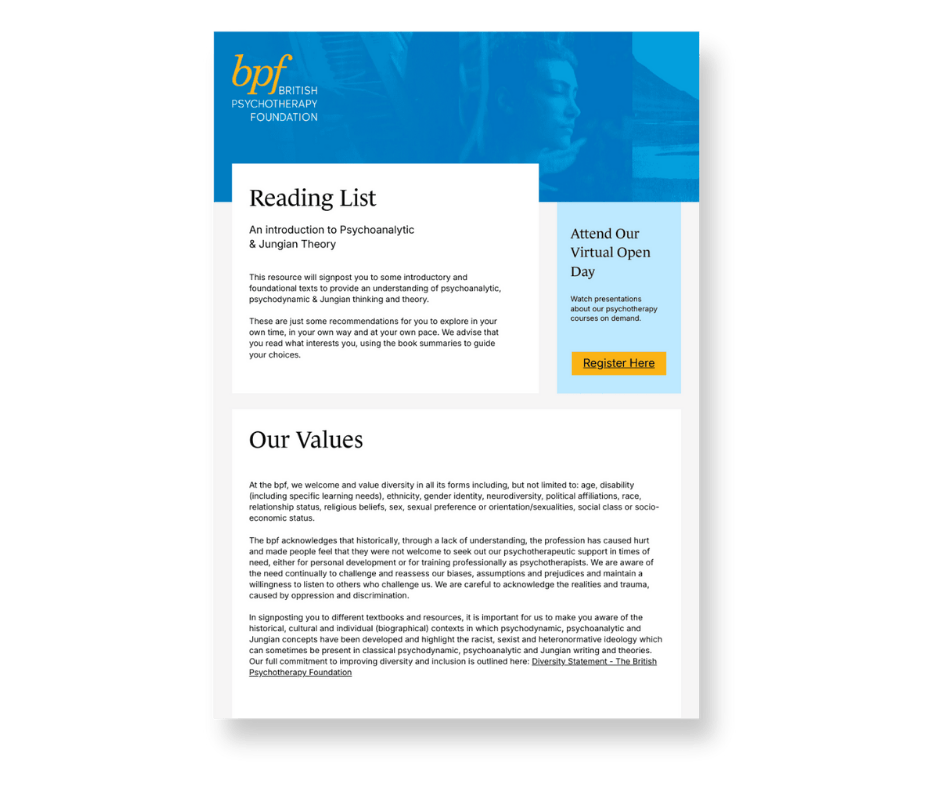
Make a £10 Donation – Receive a Psychoanalytic Reading List
Donating supports our mission to make our psychotherapy training, clinical services, and public events affordable, accessible, and more inclusive.
Reading List: Introduction to Psychoanalytic & Jungian Theory
Receive a curated list of 67 essential texts – covering psychoanalytic, psychodynamic, and Jungian theory – ideal for both newcomers and those wanting to deepen their knowledge.