Training FAQs
Below are some of the most frequently asked questions by prospective students.
- Studying at the bpf
- Application Process
- Disclosure and Barring Service
- Student Policies & Regulations
- Accessibility
Studying at the bpf
I’m thinking of studying with the bpf, where should I start?
If you have little experience, take a look at our pre-qualification courses here.
If you have some experience and/or training, our professional courses will help you become a psychotherapist. Take a look at these here. For practicing psychotherapists who are fully qualified, we have specialist courses to help you boost your skills (and learn some new ones).
Take a look here.
The course I’m interested in says I need to have private therapy?
For many of our courses, it is essential that students undertake private therapy.
In doing so:
- Students get far more from their training;
- Become more confident therapists;
- Increase self-awareness and knowledge;
- Students discuss issues in safe, secure environment.
If you’ve been accepted on a bpf course, we can help with sourcing an appropriate therapist. To find out more, please contact the course administrator for the course you are interested in. You can contact the relevant course administrator via our contact page here.
Do I need to become a member to study with the bpf?
- If you are considering a pre-qualification course, you will need to become a Foundation Member.
- If you are studying a professional qualification, you will need to join as a Training Member.
- Qualified, practicing individuals who take a post-graduate course, will need to join as either a Professional Member or, as a Pre-retirement, Teaching and/or Supervisory Member (depending on their level of experience).
- You can view all of our membership options here.
How many hours of self-study should I do a week for my course?
This varies according to the course and depends on the course. We recommend a minimum for all professional level qualifications of twelve to fifteen hours per week. For more advanced courses, around twenty to thirty (dependent on the course level, as a doctorate would require more hours than some other post-qualification courses).
You can find out about the application deadlines by contacting the administrator for the course you are interested in via our contact page, here.
Application Process
How long does the application process take?
This varies according to the course. You can find out how long by contacting the administrator for the course you are interested in via our contact page, here.
What is the application process?
This depends on the course. You can find out the course application process by visiting the course page you are interested in and clicking ‘Entry Requirements’ tab.
Alternatively, you can contact the course administrator for the course you are interested in via our contact page, here.
When is the deadline for applications?
This varies according to the course. You can find out about the application deadlines by contacting the administrator for the course you are interested in via our contact page, here.
Disclosure and Barring Service
What should I expect from the DBS process?
Please see our detailed guide about DBS checks for trainees below:
See here for a visual guide on completing the online ID verification:
Visual guide to completing TrustID digital ID verification process
You can also see our full DBS policy below:
Who can I contact if I have further questions about DBS checks?
If you have any questions about DBS checks, you can contact your relevant course coordinator, or send them to [email protected]
Where can I find your student policies and regulations?
Accessibility
Accessing the bpf building
The bpf building has limited access. We want to accommodate as much as we can. If you do have accessibility requirements, please do contact us on 0208 452 9823 or via [email protected] and we will do our best to accommodate.
I have a vision or hearing impairment, is there help available whilst studying?
Yes, we can provide advice and support for students. Please refer to our Learning Support Agreement Guidance for more information. Please do contact us on 0208 452 9823 or via [email protected] and we can discuss your individual learning needs.
I have a specific learning need (dyslexia, dyspraxia etc.). Is there help available?
Yes, we can provide advice and support for students. Please refer to our Learning Support Agreement Guidance for more information. Please do contact us on 0208 452 9823 or via [email protected] and we can discuss your individual learning needs.
Can I visit the bpf?
Yes, we welcome visitors to the organisation. To take a look at where we are, arrange a visiting time and our opening hours, please click here.
The standard of teaching was exceptional, and the course structure fostered an environment conducive to our growth and development as clinicians. Regular weekly supervision sessions allowed us to strengthen our peer relationships while deepening our learning.
bpf Student
Simply, it exceeded all my expectations, and sufficiently impressed and enthused me to consider a future career in psychotherapy. On a personal level it has changed me; something that has been accelerated by beginning my own personal analysis. I find myself thinking about non-verbal communications much more as a consequence of having attended the course.”
bpf Student
The course has allowed me to dip my toe into the analytic world and provided a broad overview of the analytic landscape. It has enhanced my understanding of psychoanalytic ideas and I’ve particularly benefited from speaking to experienced clinicians. The discussion groups in particular have been useful to clarify my own ideas and get a different perspective from others. Overall, it has helped me to determine if I would like to pursue work in this field.”
bpf Student
Apply to start in 2027
- Freud: Advanced Studies Taught in London from Sep 2027
- Certificate in Autism and Mental Health Online from Jan 2027
- Diploma in Psychodynamic Supervision Online from Mar 2027
- Summer School: Foundations of Psychoanalytic & Jungian Psychotherapy Online, Summer 2027
- Experiential Weekend: An Introduction to Psychoanalytic and Jungian Thinking In-person, November 2027
- Experiential Weekend: Deepening Analytic PracticeIn-person, October 2027
- Work Discussion: Understanding Children and Families from a Psychoanalytic Perspective Online, September 2027
- Psychiatry for Psychotherapists In-person, 2027
Upcoming Events
When Societies Lose Their Minds – Date: 14/10/2026 Time: 19:00 – 21:00 GMT, Online via Zoom. Lord John Alderdice, Dr Gwen Adshead and Professor Josh Cohen explore violence at both an individual and societal level. Click here to register.
Hierarchies and Fragmentations in Psychoanalysis: In-person Conference – 21 November 2026 | 10.00am – 5.00pm. Location: London (LIFT Islington). A conference exploring how psychoanalysis and Jungian analysis can evolve, adapt and thrive in the 21st century. Click here to register.

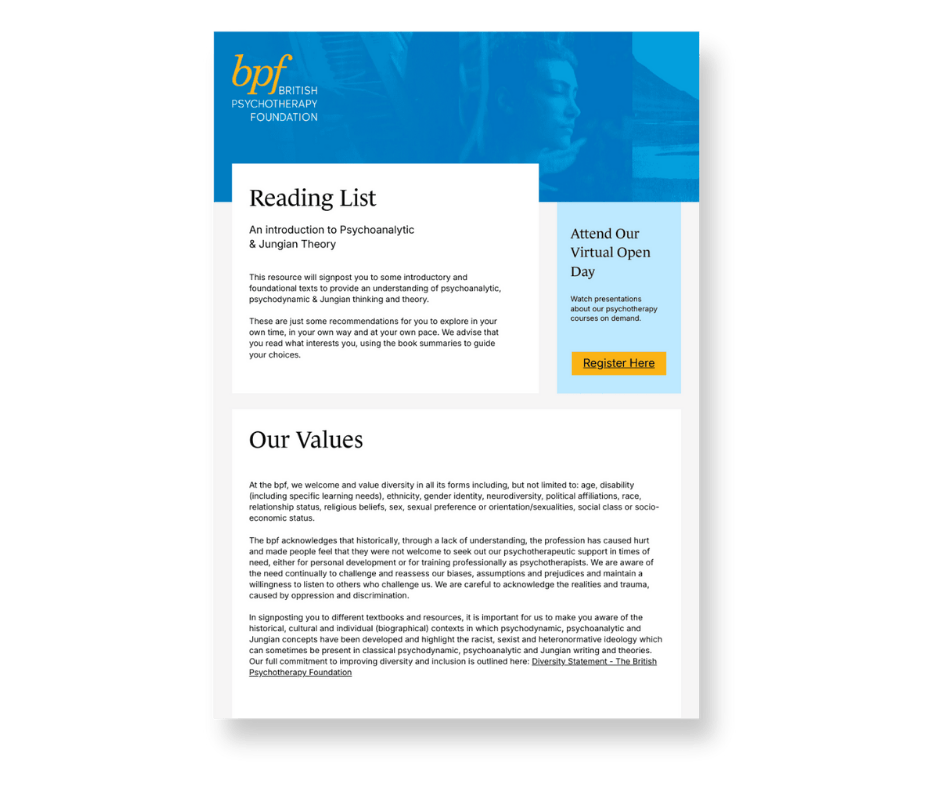
Make a £10 Donation – Receive a Psychoanalytic Reading List
Donating supports our mission to make our psychotherapy training, clinical services, and public events affordable, accessible, and more inclusive.
Reading List: Introduction to Psychoanalytic & Jungian Theory
Receive a curated list of 67 essential texts – covering psychoanalytic, psychodynamic, and Jungian theory – ideal for both newcomers and those wanting to deepen their knowledge.