Infant Observation
This course provides an opportunity to develop knowledge and understanding of human development through direct observation of an infant during its early life. The body of knowledge is drawn from the main psychoanalytic schools. The course contains experiential and some theoretical learning.
On satisfactory completion of the Infant Observation Paper participants are awarded a Certificate by the bpf. Those opting not to write will receive a Certificate of Attendance.
Applications are accepted throughout the year.
Please find the Application Form below. Once completed, send it to [email protected].
- Eligibility
- Course Content
- Course Structure
- Entry Requirements
- Fees
- Resources
- Access Information
- How to Apply
Anyone who works with people will benefit from undertaking an Infant Observation, especially therapists and counsellors.
For those considering training in psychotherapy or analysis, it is indispensable in helping to develop your ‘analytic attitude’ – the capacity to maintain an objective stance while remaining emotionally open and reflecting on your countertransference responses.
The experience can activate early developmental areas of the psyche, which is why it is such a valuable aspect of training and also why individual Psychoanalytic or Jungian therapy (minimum 1 x weekly) throughout the course is essential for all applicants.
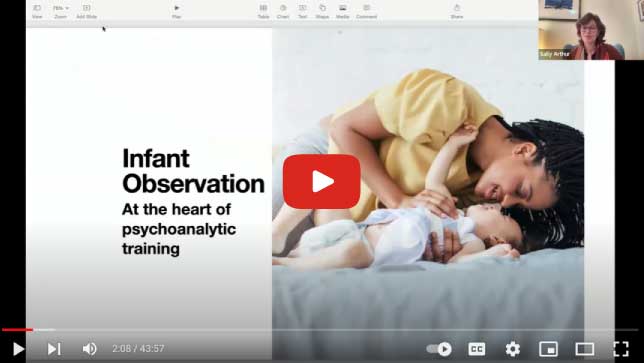
Click here to watch the open day video.
Participants observe a baby from birth until two years of age, paying close attention to how they relate to their carers and environment.
Observing an infant fine-tunes your ability to notice intricate and subtle details and recall sequences of interactions. By reflecting on your observations in a small seminar group, you then build up a picture of the unfolding inner world of the infants and their relationships.
The seminars offer a place to ‘feel into’ or empathically imagine the baby’s experience, to be curious and to explore ideas about what might be going on in the baby’s inner world.
The aims of the course are to help you to:
- Develop a keen understanding of the ways in which human beings develop
- Witness the intense psychosomatic experience of the human infant
- Enhance your attunement to non-verbal and pre-verbal communication
- Sharpen all your observational skills
- Deepen your attentiveness and analytic attitude
- Enrich an appreciation of counter-transference experiences
- Enhance clinical practice
The group and the seminar leader will help you to identify a suitable family who are expecting a baby. Participants then visit the infant in their family setting from birth. People observe until the baby’s second birthday.
In the seminars, each participant presents their observations in turn for confidential group discussion. The discussion is a chance to clarify, amplify and explore ideas about what might be happening at all sorts of levels. It can be especially fascinating to discover more about non-verbal and pre-verbal communication, and early states of mind and to see the difference between the various infants’ personalities and experiences.
While the seminar leader and the group will offer as much support as possible, if a student has not been able to find a family expecting a baby after 3 terms, we will review your place on the course with you.
Psychoanalytic Psychotherapy Association (PPA) Trainees
PPA trainees are only required to complete a one‑year observation, although they may choose to extend this period until the child’s second birthday. While the observation itself spans one year, trainees should note that identifying a suitable family and baby may take some time, and that seminar attendance is required for as long as their observation is ongoing. Consequently, the overall completion of the course exceeds one year, and is likely to take two years or longer.
PPA trainees needing to attend additional seminars beyond the two years, a termly fee will be payable. Please refer to our fees page here: Fees – The British Psychotherapy Foundation.
Please note that the option to complete a one-year observation is only available to those who have been offered a place on the PPA Training. Those who have not yet been accepted onto the training will be expected to complete the two-year observation.
Observations last one hour a week throughout the year allowing for everyone’s holiday commitments, and after each visit, students write up detailed notes of what has been observed. The minimum time commitment for attending the observation, the seminar and writing up notes is half a day a week.
A number of seminar groups run at a variety of times on different days of the week in-person and online. Further information can be given at interview and at the time of acceptance.
Structure
- 10 seminars per term, 3 terms a year. There is a maximum number of 5 participants in each group.
- It may take longer than two years to complete the course. Additional terms will be charged separately.
- At the end of the course, participants are encouraged to write an Infant Observation paper. If applying to the bpf adult Jungian, Psychoanalytic or the Child and Adolescent Training, it may be considered a component module.
It is possible to join a seminar group at any point in the year depending on space availability. Participants who write a final paper will be awarded a Certificate by the bpf. Those opting not to write will receive a Certificate of Attendance.
Time & location of the Infant Observation seminars
Infant Observation seminars are delivered either in-person or online, with different groups meeting on different days and times throughout the week. Places in each group are limited to a maximum of 5 participants. This means that, on some occasions, successful applicants may need to wait until a place becomes available in a suitable group, or a new group is formed.
We endeavour to find a suitable place for successful candidates as quickly as is possible.
- Anyone who works with people will benefit from undertaking an Infant Observation, especially therapists and counsellors.
- For those considering training in psychotherapy or analysis, this experience is indispensable in helping to develop your ‘analytic attitude’ – the capacity to maintain an objective stance while remaining emotionally open and reflecting on your countertransference responses.
- An infant observation can activate early developmental areas of the psyche, which is why it is such a valuable aspect of training and also why individual Psychoanalytic or Jungian therapy (minimum 1 x weekly) throughout the course is essential for all applicants.
All applicants will be interviewed for suitability.
On acceptance of an offer, all successful applicants will need to apply for DBS clearance at the Enhanced level before starting an observation. This can be done via the bpf.
Fees
| Infant Observation | Years 1-2 | 1845* (from April 2026) |
| Years 3+ (p/term) | 334 (from April 2026) |
In the Infant Observation course, each student is expected to observe a baby for two years. Because finding a suitable baby can take time, students usually end up attending seminars for longer than two years. If a student needs to continue attending seminars after completing the two‑year observation period, they must pay for each additional term. These extra terms are charged separately.
PPA trainees who need to continue attending seminars beyond the standard two‑year period, will be required to pay a fee for each additional term. These extra terms are charged on a term‑by‑term basis.
The Infant Observation course is not eligible for instalment payment plans.
Payment structure
- An application fee of £170 covering two interviews is due at the point of submission. Those already training with the PPA or BJAA will be required to pay an application fee of £90.
- Upon receiving an offer of a place, participants are required to pay a non-refundable deposit fee of £400 to secure their place. Once a suitable group is identified, participants will be required to pay the remainder of their annual fee before joining seminars.
- The fee for the second year of the Infant Observation course becomes due 12 months after the initial annual payment. Participants are formally enrolled on the course from the point at which their first annual fee is paid and a seminar group has been allocated.
- Any additional terms attended will be charged separately. Please refer to our course fee page for further details: view course fees.
Please note that fees will be subject to annual increases in line with inflation in the UK.
The Infant Observation Course is primarily experiential, and we discourage you from reading theory, especially in the early stages of your observation. Theoretical concepts may be helpful when relevant to the individual observations under discussion and will be required when you come to write your final paper. Seminar leaders can be approached for guidance.
Attend our Virtual Open Day to watch a presentation about this course.
Blogs
Frequently Asked Questions About Psychodynamic Psychotherapy
How to become a psychotherapist in the UK – The British Psychotherapy Foundation
My Journey as a Black Trainee in Psychodynamic Psychotherapy – The British Psychotherapy Foundation
How Couples Psychotherapy Can Transform Relationships – The British Psychotherapy Foundation
Why become a psychotherapist? (part I)
Why become a psychotherapist? (part II)
Videos
What’s it like to be a psychotherapist? Psychoanalytic psychotherapist (youtube.com)
What’s it like to be a psychotherapist? Child and Adolescent Psychotherapist (youtube.com)
What’s it like to be a psychotherapist? Jungian Analyst (youtube.com)
The building has limited access – Please call us on 020 8452 9823 to discuss your needs.
Application Fee:
- For current PPA or BJAA trainees, the application fee is £90.
- For all other applicants, the application fee is £170.
The application fee covers the cost of required interviews. Your application cannot be processed until you pay the application fee.
To apply for this course, click below:
Applications are accepted throughout the year. There is high demand for places on this course and for some groups there is a waiting list.
The standard of teaching was exceptional, and the course structure fostered an environment conducive to our growth and development as clinicians. Regular weekly supervision sessions allowed us to strengthen our peer relationships while deepening our learning.
bpf Student
Simply, it exceeded all my expectations, and sufficiently impressed and enthused me to consider a future career in psychotherapy. On a personal level it has changed me; something that has been accelerated by beginning my own personal analysis. I find myself thinking about non-verbal communications much more as a consequence of having attended the course.”
bpf Student
The course has allowed me to dip my toe into the analytic world and provided a broad overview of the analytic landscape. It has enhanced my understanding of psychoanalytic ideas and I’ve particularly benefited from speaking to experienced clinicians. The discussion groups in particular have been useful to clarify my own ideas and get a different perspective from others. Overall, it has helped me to determine if I would like to pursue work in this field.”
bpf Student
Last Chance to Apply for Autumn 2026
- Assessment Skills Training (London, Starts 3rd Oct 2026)
- Foundation Course – Psychotherapy & Counselling (London / Online, Oct 2026)
- Jungian Dreams Workshop (Online, Oct 2026)
bpf North:
- Psychoanalytic & Psychodynamic Psychotherapy Training (Taught in Newcastle & Online, Oct 2026)
- Foundation Course (Taught in Newcastle, Oct 2026)
New in 2027
- Freud: Advanced Studies (Taught in London from Sep 2027)
- Certificate in Autism and Mental Health (Online from Jan 2027)
- Diploma in Psychodynamic Supervision (Online from Mar 2027)
Upcoming Events
When Societies Lose Their Minds – Date: 14/10/2026 Time: 19:00 – 21:00 GMT, Online via Zoom. Lord John Alderdice, Dr Gwen Adshead and Professor Josh Cohen explore violence at both an individual and societal level. Click here to register.

Make a £10 Donation – Receive a Psychoanalytic Reading List
Donating supports our mission to make our psychotherapy training, clinical services, and public events affordable, accessible, and more inclusive.
Reading List: Introduction to Psychoanalytic & Jungian Theory
Receive a curated list of 67 essential texts – covering psychoanalytic, psychodynamic, and Jungian theory – ideal for both newcomers and those wanting to deepen their knowledge.