bpf North: Psychoanalytic & Psychodynamic Psychotherapy Training
Clinical Training
Location: Monthly Saturday study days in Newcastle upon Tyne, with weekly seminars Online.
Train to become a psychoanalytic or psychodynamic psychotherapist in the North East of England (Newcastle upon Tyne). We anticipate that a Modified Entry will be available to qualified practitioners looking to retrain.
The bpf North training incorporates best clinical practice and high standards, and it is accredited by the British Psychoanalytic Council. Once qualified, you will be able to register for full bpf membership. You will be eligible for registration with the British Psychoanalytic Council, which is regulated by the Professional Standards Authority.
With this training, therapists are well equipped to work with adult patients in private practice, or to apply the model to work in the NHS, higher education and the third sector. Further training and CPD opportunities are available to all bpf members.
bpf North will also be launching a new Foundation Course in Newcastle in September 2025.
Applications are accepted throughout the year.
Successful applicants may join the rolling programme during the academic year.
Attend Open Day (Online)
bpf North Training – Open Day (Online) on Saturday 30th May, 2026, 10:30-12:00
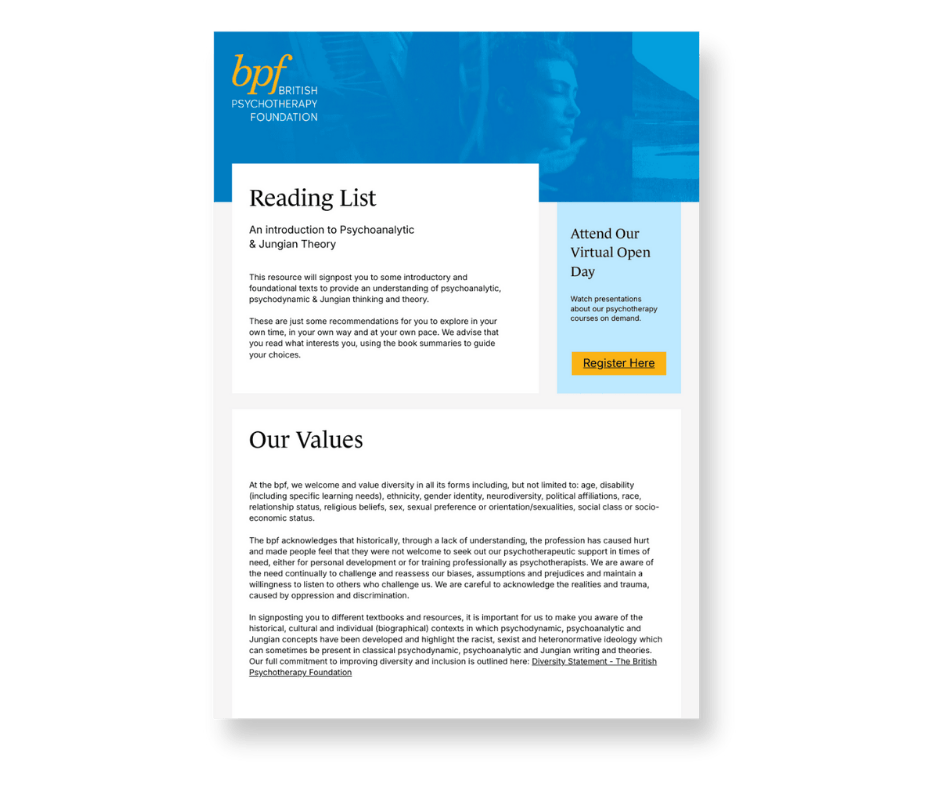
Download Free Reading List
This reading list highlights six key texts that offer an introduction to psychoanalytic, psychodynamic, and Jungian theory.
Watch the bpf North Virtual Open Day
Next intakes: January 2026, April 2026, October 2026.
- About the training
- History of the training
- Course structure
- Course Fees
- Entry requirements
- Resources
- How to apply
- Contact us
The bpf North’s Psychodynamic / Psychoanalytic Psychotherapy Training offers a pathway to becoming a psychoanalytic or psychodynamic psychotherapist. This training is accredited by the British Psychoanalytic Council (BPC). This part-time training includes a combination of in-person and online teaching. The structure is designed to fit around current work commitments.
Trainees can apply to take psychoanalytic pathway, which will prepare them to work with patients three-times-per-week, or the psychodynamic pathway, which will prepare them for once-per-week work with patients.
Psychoanalytic/psychodynamic psychotherapy is based upon psychoanalytic theory and practice, and derives from knowledge of the unconscious processes that influence the mental life of the individual. Psychoanalytic psychotherapy utilises this knowledge to promote psychological development and to treat and prevent mental suffering, illness and dysfunction in individuals, groups and organisations.
Course graduates may expect to use their professional training and qualification as the basis for both autonomous independent practice and a career in the NHS.
Attend our Virtual Open Day to watch a presentation about this course.
Formerly run by the North of England Association of Psychoanalytic Psychotherapists (NEAPP), this training was established in 1992. It was the first training in England outside London to be accredited by the British Psychoanalytic Council (BPC).
In 2024, NEAPP joined the British Psychotherapy Foundation, forming the bpf North.
This part-time training includes a combination of in-person and online teaching. The structure is designed to fit around current work commitments.
We intend to teach this course on Saturday study days in Newcastle upon Tyne (once per month), alongside online seminars. This will make the training more accessible for trainees in surrounding cities in the North of England, such as Leeds, Manchester, Bradford, Liverpool, and Sheffield. This structure also makes training more feasible for those who live in some areas of Scotland, such as Edinburgh and the surrounding areas.
2025/26 Term Dates
In-person Saturdays in Newcastle:
· Autumn 2025: 4 October / 8 November / 13 December
· Spring 2026: 10 January / 7 February / 7 March
· Summer 2026: 18 April / 9 May / 20 June / 18 July
Online week theory seminars on Tuesday evening, 6.30-9.30pm during termtime. This includes an Infant Observation seminar.
Training as a Psychoanalytic Psychotherapist
On the psychoanalytic psychotherapy pathway, the training takes a minimum of four years. This pathway is intended for those who wish to work with patients three times per week.
There are five core components to the course:
- Personal psychoanalytic psychotherapy or psychoanalysis at a minimum frequency of three times per week with an experienced psychoanalyst or psychoanalytic psychotherapist approved by the Training Committee. This should begin one year or more before the academic course, and continue at least until qualification for membership.
- Theoretical seminars.
- Clinical seminars.
- Observation of an infant with associated seminars.
- Supervised psychoanalytic psychotherapy treatment of two patients.
Training as a Psychodynamic Psychotherapist
On the psychodynamic psychotherapy pathway, the training takes a minimum of four years. This pathway is intended for those who wish to concentrate on working once or twice a week with patients.
There are five core components to this pathway:
- Personal psychoanalytic psychotherapy or psychoanalysis at a minimum frequency of once per week with an experienced psychoanalyst or psychoanalytic psychotherapist approved by the Training Committee. This should begin one year or more before the academic course, and continue at least until qualification for membership.
- Theoretical seminars
- Clinical seminars
- Observation of an infant with associated seminars
- Supervised treatment of two patients in psychodynamic psychotherapy
Modified Entry – Training as a Psychoanalytic Psychotherapist
For those who are already trained as Child and Adolescent Psychotherapists with the Association of Child Psychotherapy, or Adult Psychoanalytic/Psychodynamic Psychotherapists who are not registered with the BPC, we may be able to offer a modified entry to this training.
After discussion with the trainee, the Training Committee may relax the requirements for theoretical seminars to take account of study already undertaken in earlier training. Adult psychotherapists who have not attended Infant Observation Seminars will have to complete a year’s observation of a baby and write a paper on their experience.
Undertaking a clinical training in Psychoanalytic / Psychodynamic Psychotherapy represents a major personal investment in terms of time, money and individual development. If clinical work needs to continue beyond the four years, there is a reduction in the annual fee.
We are currently unable to offer financial support to trainees. However, we review our fees regularly with the aim to keep them as affordable as possible. The bpf does not subsidise transport or accommodation expenses.
Personal therapy and supervision are not included in the course fees. The cost of personal therapy is negotiated with the Training Therapist on an individual basis. Similarly, when beginning to work with training patients, the cost of supervision will be discussed with each Training Supervisor. Trainees will need to provide an appropriate setting to see training patients, and this may involve room rental costs.
View Course Fees
Course fees are subject to annual increase. A full academic year consists of 3 terms.
- If clinical work needs to continue beyond the four years of the training, there is a reduction in the annual fee (subject to annual increase).
- Infant Observation is included in the annual fees for this training.
- Trainees also pay an annual bpf membership fee, which provides access to the bpf library, to PEPWEB (an excellent online resource of psychoanalytic literature), and access to bpf’s wide-ranging scientific and cultural life. This is now included in the course fee.
For more information, visit this page to view the latest course fees.
Ilse Seglow Bursary Fund
In memory of Ilse Seglow (1900-1984) her family has set up a bursary. This is intended to provide financial support to those with limited means so enabling them to further their professional development and training in psychoanalytic psychotherapy.
Personal Therapy
Applicants will have been in psychoanalytic psychotherapy with a BPC-accredited practitioner for 1 year prior to the course start date. The psychotherapist you choose needs to be experienced (we normally ask that they have 5 years of work experience since they qualified). The therapy should be in-person.
We always recommend that you contact us before starting with a new therapist to check that the therapist will be suitable for this training. Please email us with any questions, and we will be able to offer guidance.
Those wishing to undertake the psychoanalytic pathway need to be in psychoanalytic psychotherapy at a minimum frequency of three times per week, for at least one year prior to the course start date.
Those wishing to undertake the psychodynamic pathway need to be in psychoanalytic psychotherapy once per week, for at least one year prior to the course start date.
Infant Observation (Psychoanalytic Psychotherapy Pathway)
This component allows the trainee to gain first-hand experience of the development of an infant and their attachments, and therefore to develop a greater understanding of the early states of mind and human experiences which exist within us all. It also facilitates the development of a capacity to experience and observe intense emotional states both in the mother and baby and in the observer themselves.
Trainees are required to observe a mother and baby in the family setting once a week for an hour. Detailed reports on these observations are written, which are then discussed at a weekly seminar led by an experienced psychotherapist. The observations begin at birth and continue for a one or two years. The length of the observation is agreed with the family at the outset. A piece of written work on the observation is to be completed before beginning with the first training patient.
Selection
Selection of candidates for training is made on the basis of qualities directly concerned with the ability to learn and to function as a psychodynamic/psychoanalytic psychotherapist, and each application is carefully considered on an individual basis.
Successful applicants have generally gained some experience of working with adults with emotional difficulties within a one-to-one relationship, either professionally or on volunteer basis. Many applicants have an academic qualification, but we also accept applications from those without formal higher education qualifications who are able to demonstrate the capacity to undertake the academic components of the course.
An application is likely to be strengthened by having some familiarity with psychoanalytic ideas.
Following acceptance onto the course, those without previous psychiatric experience may need to undertake a psychiatric placement, either before or during the training.
Those with little relevant clinical experience will need to undertake a clinical placement. All trainees need to be engaged in one-to-one therapeutic work with adults during the first pre-clinical year of the training as a foundation for working more intensively, and so that they can participate fully in the weekly clinical seminars.
Residence and Language
Enrolment on any of our bpf North trainings does not currently qualify for a visa.
All applicants for the are required to hold indefinite right to remain (ILR) in the UK, and to be in a position to support themselves financially during the training, which is an intensive clinical programme requiring long-term, in-person work with training patients.
Qualification is dependent on the completion of long-term clinical work with training patients in person. It is normally the case that trainees may take up to 5 or more years to qualify as psychoanalytic psychotherapists. For this reason, considering that our programme does not currently qualify for a visa, we are unable to accept applications from those who do not hold indefinite right to remain (ILR) in the UK.
Our training is delivered in English. Where English is not their first language, applicants may be asked to demonstrate that their use of spoken and written English is sufficient to participate in the academic and clinical components of the course.
Other Requirements
It is usually expected that applicants will have completed a foundation course in psychoanalytic/psychodynamic theory prior to applying to this training.
Successful applicants will need to apply for a DBS check or provide a valid certificate. For more information, please visit our Training FAQs page here: Training FAQs – The British Psychotherapy Foundation.
Resources
Blogs
Frequently Asked Questions About Psychodynamic Psychotherapy
How to become a psychotherapist in the UK – The British Psychotherapy Foundation
My Journey as a Black Trainee in Psychodynamic Psychotherapy – The British Psychotherapy Foundation
How Couples Psychotherapy Can Transform Relationships – The British Psychotherapy Foundation
Why become a psychotherapist? (part I)
Why become a psychotherapist? (part II)
Videos
What’s it like to be a psychotherapist? Psychoanalytic psychotherapist (youtube.com)
What’s it like to be a psychotherapist? Child and Adolescent Psychotherapist (youtube.com)
What’s it like to be a psychotherapist? Jungian Analyst (youtube.com)
Applications for this training are accepted on a rolling basis. Entry points take place once a term in Spring, Summer and Autumn.
The next intakes are: Spring 2026, Summer 2026 and Autumn 2026.
To start the application process, please first complete this questionnaire and return it to: [email protected]
There is a non-refundable application fee of £170. This fee covers two interviews.
On offer of a place on our trainings, successful applicants will be required to pay a non-refundable £400 deposit fee in order to secure their place.
If you have any questions about this training, please email us at: [email protected]
The standard of teaching was exceptional, and the course structure fostered an environment conducive to our growth and development as clinicians. Regular weekly supervision sessions allowed us to strengthen our peer relationships while deepening our learning.
bpf Student
Simply, it exceeded all my expectations, and sufficiently impressed and enthused me to consider a future career in psychotherapy. On a personal level it has changed me; something that has been accelerated by beginning my own personal analysis. I find myself thinking about non-verbal communications much more as a consequence of having attended the course.”
bpf Student
The course has allowed me to dip my toe into the analytic world and provided a broad overview of the analytic landscape. It has enhanced my understanding of psychoanalytic ideas and I’ve particularly benefited from speaking to experienced clinicians. The discussion groups in particular have been useful to clarify my own ideas and get a different perspective from others. Overall, it has helped me to determine if I would like to pursue work in this field.”
bpf Student
New Courses & Reading Groups
- Certificate in Psychodynamic Couple Theory – (Hybrid – London & Online , Starts September 2026)
- Intensive Summer School: Foundations of Psychoanalytic & Jungian Psychotherapy – (Taught Online, Thursday 16th to Monday 20th July, 2026)
- Psychodynamic and Jungian Theory for Qualified Practitioners – (Taught Online, October 2026)
- Reading Group – ‘Reading Bion’ – (Taught Online, Commences January 2027)
- Reading Group – ‘Reading Freud’ – (Taught Online, Commences January 2027)
- Reading Group – Psychoanalytic Psychotherapy Association – (Taught Online, Rolling Entry)
bpf North:
- Foundation Course (Taught in Newcastle, October 2026)
- Psychoanalytic & Psychodynamic Psychotherapy Training (Taught in Newcastle & Online, October 2026)
Upcoming Events
- Hierarchies and Fragmentations in Psychoanalysis – Date(s): 23rd April, 14th May, 2nd July & 12th September, 2026. Venue: Online and In Person. Event series + conference, in collaboration with CPJA and UKCP. Find out more.

Make a £10 Donation – Receive a Psychoanalytic Reading List
Donating supports our mission to make our psychotherapy training, clinical services, and public events affordable, accessible, and more inclusive.
Reading List: Introduction to Psychoanalytic & Jungian Theory
Receive a curated list of 67 essential texts – covering psychoanalytic, psychodynamic, and Jungian theory – ideal for both newcomers and those wanting to deepen their knowledge.