Experiential Weekend: An Introduction to Psychoanalytic and Jungian Thinking
In-person Experiential Weekend for Beginners
This experiential weekend offers a rare opportunity to encounter the insights from psychoanalytic and Jungian psychotherapeutic practice and the vitality of group process in a welcoming, beginner-friendly setting. Whether your interest lies in training as a psychotherapist or simply in developing greater self-awareness and compassion, you will finish the weekend with new insights, practical tools, and the confidence to continue your journey.
Across the weekend, you will take part in thoughtfully crafted group activities, reflective exercises, and discussions that invite exploration of your inner world, guided by experienced facilitators from the bpf membership and wider psychoanalytic and Jungian community. No previous knowledge of psychotherapy, psychoanalysis, or Jungian thinking is required. All you need is an open mind and a willingness to explore.
The group will include up to 16 participants.
Provisional Dates: Weekend, 13th/14th of November 2027.
We are accepting expressions of interest for Autumn 2027.
Provisional Dates: Weekend, 13th/14th of November 2027.
Please register your interest and you will be sent an application form when applications open.
Fees
Weekend Programme: *£560
*Prices are indicative and will be confirmed closer to launch.
Are you a clinician? Our Experiential Weekend: Deepening Analytic Practice weekend is designed for clinicians, with prior clinical experience needed.
- Course Aims
- Who Is This For?
- Facilitation and Ethos
- Course Structure
- Fees
- How to Apply
- Access information
Course Aims
The course provides a beginner-friendly and inclusive introduction to key concepts in psychoanalytic and Jungian psychology. Participants will be introduced to ideas about the unconscious, symbolism, relational dynamics, and the deeper structures that shape emotional life, all in an accessible and engaging way.
A central aim is to foster personal growth and self-awareness through experiential learning in a group context. The weekend is designed to help participants reflect on their own emotional patterns and inner world while gaining confidence in exploring these themes with others.
The weekend also offers a gentle taster of what training with the bpf entails. Participants will have the opportunity to meet practitioners, ask questions, and experience elements of the reflective, process-oriented learning style characteristic of analytic training.
Finally, the course encourages lively and respectful curiosity about the self and others. Diversity of perspective and experience is welcomed, and the group space is held to support thoughtful dialogue, openness, and mutual exploration.
Who Is This For?
This weekend is ideal for people who are taking their very first steps into the world of psychotherapy and personal development. It offers a welcoming introduction for those who may feel curious but uncertain about where to begin.
It is particularly suited to individuals considering applying for a bpf training but unsure which pathway to pursue or what analytic study might involve. The weekend provides a safe, low-pressure way to explore these questions.
The course is also designed for those interested in understanding more about their own emotional life and unconscious patterns. Participants with an interest in self-reflection, insight, and emotional development often find this kind of work especially meaningful.
People drawn to psychoanalytic or Jungian ideas, but with little or no prior experience, will find the weekend accessible and engaging. No theoretical background is required.
Finally, the weekend welcomes anyone seeking a supportive and creative environment in which to explore feelings, imagery, and interpersonal dynamics. The group setting offers both connection and space for individual reflection.
Are you a clinician? Our Experiential Weekend: Deepening Analytic Practice weekend is designed for clinicians, with prior clinical experience needed.
Facilitation and Ethos
The weekend is facilitated by experienced practitioners from the bpf and the wider psychoanalytic and Jungian community. They bring a rich blend of clinical experience, group work skills, and a deep appreciation for the inner world.
Facilitators are committed to creating a warm, non-judgmental space in which all voices feel welcome. Great care is taken to support participants who may be engaging with this kind of work for the first time.
A central element of the ethos is honouring both the vulnerability and courage involved in beginning a psychotherapeutic journey. Facilitators hold the group with sensitivity, curiosity, and respect for each person’s pace.
Theory is balanced with lived experience throughout the weekend. Group process, experiential activities, and reflective exercises bring analytic ideas to life in ways that resonate personally as well as intellectually.
Creative exploration is encouraged through art-making, dream material, storytelling, and symbolic imagery. These forms of expression offer varied pathways into the unconscious and support different learning styles.
Finally, confidentiality and psychological safety are treated as essential. Clear boundaries and group agreements help ensure that the space remains containing, respectful, and supportive for everyone involved.
Course Structure
This intensive weekend is structured to balance learning, group experience, and personal reflection. Each element is carefully designed to invite participants into the world of analytic thinking, providing both intellectual understanding and lived experience.
Please note: this course content is provisional and may be subject to change.
Saturday Morning: Foundations of Analytic Thinking
- Arrival and Introductions. A warm welcome, settling in, and meeting your facilitators and fellow group members.
- Opening Circle. Setting group agreements, intentions, and motivations, and discussing confidentiality and safety in group work.
- What Is Psychoanalysis? A brief, interactive overview introducing key concepts such as the unconscious, transference, resistance, and the role of free association.
- What Is Jungian Analysis? Exploring Jung’s ideas, including archetypes, the collective unconscious, the shadow, and individuation.
- Small-Group Discussions. Breakout groups reflecting on personal experiences of ‘not knowing why we do what we do’, shared in a spirit of curiosity rather than problem-solving.
- Experiential Exercise – The Symbolic Image. Using art materials, participants create an image or collage that resonates with them, followed by facilitated reflection on the feelings or associations that arise.
Saturday Afternoon: Working With Dreams and the Shadow
- Introduction to Dreamwork. How psychoanalytic and Jungian practitioners approach dreams, noting both similarities and differences.
- Dream Group. In a confidential, supportive circle, participants work together on one or two volunteered dreams. Facilitators model gentle inquiry and association rather than interpretation.
- The Shadow Self. Presentation and group exercise exploring how we relate to our own ‘shadow’. Guided reflection on aspects of ourselves we find difficult, using writing or drawing.
Saturday Evening: Storytelling and the Collective Unconscious
- Myth and Metaphor. A storytelling session drawing on myths and fairy tales from the Jungian tradition, exploring how collective themes appear in our personal stories.
- Open Reflection. Group space for sharing thoughts, feelings, and questions arising from the day’s explorations.
Sunday Morning: The Therapeutic Relationship
- The Analytic Group: Holding and Containment. What makes a group feel ‘safe’? How do transference and projection play out in group settings?
- Guided Group Process. Participants experience a group session facilitated in an analytic style, focusing on here-and-now feelings and interactions, followed by debrief and reflection.
- Personal Growth and the Individuation Journey. Exploring how to continue the journey begun this weekend and what ‘individuation’ means in practice.
Sunday Afternoon: Integration and Next Steps
- Integration Exercise. Each participant creates a ‘map’ or timeline of their personal journey so far – for example, insights gained, questions emerging, and future intentions.
- Training with the bpf. A short talk and Q&A for those interested in learning more about training pathways, including discussion of what the process involves.
- Closing Circle. Gratitude, feedback, and reflections on what participants will take away from the weekend. Invitations to stay connected with the group or facilitators as desired.
Fees
Weekend Programme: *£560
*Prices are indicative and will be confirmed closer to launch.
How to Apply
Please register your interest by clicking the button below and you will be sent an application form when applications open.
Provisional Dates: Weekend, 13th/14th of November 2027.
For enquiries, please email us on [email protected].
Please email [email protected] to discuss any access needs.
Apply to start in 2027
- Freud: Advanced Studies Taught in London from Sep 2027
- Certificate in Autism and Mental Health Online from Jan 2027
- Diploma in Psychodynamic Supervision Online from Mar 2027
- Summer School: Foundations of Psychoanalytic & Jungian Psychotherapy Online, Summer 2027
- Experiential Weekend: An Introduction to Psychoanalytic and Jungian Thinking In-person, November 2027
- Experiential Weekend: Deepening Analytic PracticeIn-person, October 2027
- Work Discussion: Understanding Children and Families from a Psychoanalytic Perspective Online, September 2027
- Psychiatry for Psychotherapists In-person, 2027
Upcoming Events
When Societies Lose Their Minds – Date: 14/10/2026 Time: 19:00 – 21:00 GMT, Online via Zoom. Lord John Alderdice, Dr Gwen Adshead and Professor Josh Cohen explore violence at both an individual and societal level. Click here to register.
Hierarchies and Fragmentations in Psychoanalysis: In-person Conference – 21 November 2026 | 10.00am – 5.00pm. Location: London (LIFT Islington). A conference exploring how psychoanalysis and Jungian analysis can evolve, adapt and thrive in the 21st century. Click here to register.

Make a £10 Donation – Receive a Psychoanalytic Reading List
Donating supports our mission to make our psychotherapy training, clinical services, and public events affordable, accessible, and more inclusive.
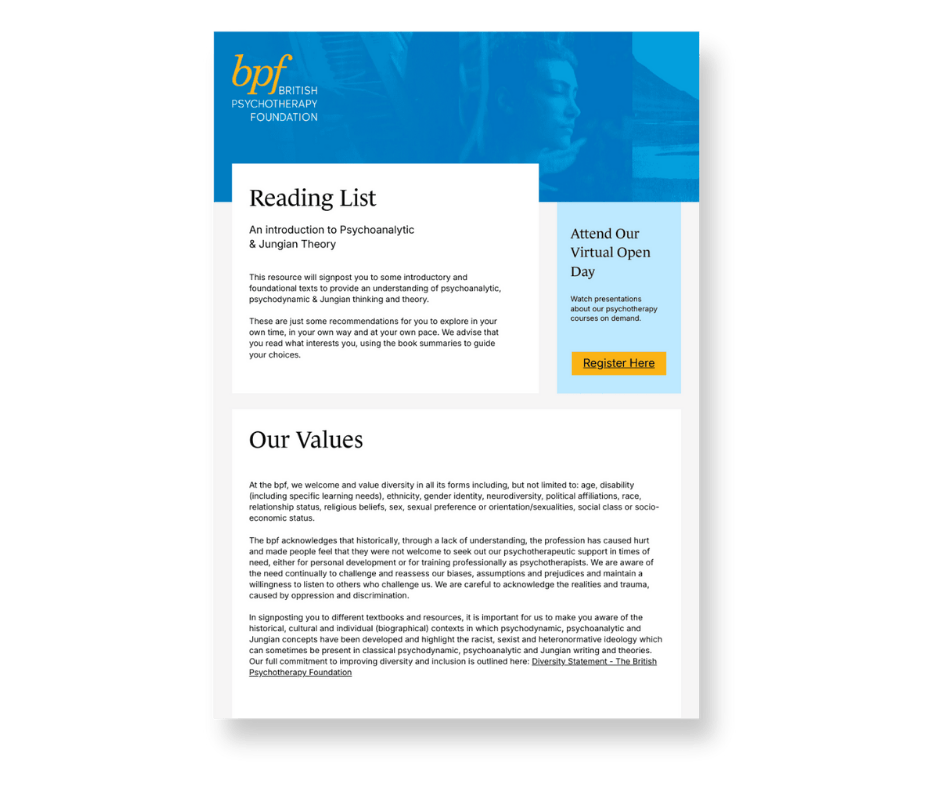
Reading List: Introduction to Psychoanalytic & Jungian Theory
Receive a curated list of 67 essential texts – covering psychoanalytic, psychodynamic, and Jungian theory – ideal for both newcomers and those wanting to deepen their knowledge.