Diploma in Psychodynamic Supervision
Two-Year Online Programme
Course length: 2 Years (Diploma); 1 Year (Certificate). Delivery: Online.
This is a two-year training for psychoanalytic and psychodynamic psychotherapists, Jungian psychotherapists and analysts, and psychodynamic counsellors wishing to develop their supervisory practice, leading to a Diploma in Psychodynamic Supervision.
Year One teaches the foundations of supervision through seminars and small teaching groups. Year Two introduces a way of supervising based on the Comparative Clinical Method (CCM) through seminars and weekly Supervision of Supervision groups. Course members may complete Year One alone and receive a Certificate in Psychodynamic Supervision, or progress to Year Two towards the Diploma.
This course is taught by experienced BPC-registered clinicians, and replaces our previous one-year Developing Supervision Skills course.
Join us for a webinar with Laurence Spurling on Wednesday, 13 January 2027 at 8:30pm.
Applications for the March 2027 intake are now open.
To apply for this programme, please follow the link below:
Please note: the contents of this course, including dates and course structure, may still change. This page contains the most current information about this programme to date.
For enquiries, please email us on [email protected].
Join us for a webinar with Laurence Spurling
Wednesday, 13 January 2027 at 8:30pm
- Course Content
- Course Structure
- Entry Requirements
- Fees
- Resources
- Access Information
- How to Apply
Course Content
This information is provisional and some details may still change before the course launches.
This is a two-year training for psychoanalytic and psychodynamic psychotherapists, Jungian psychotherapists and analysts, and psychodynamic counsellors wishing to develop their supervisory practice, leading to a Diploma in Psychodynamic Supervision.
Year One covers the foundations of supervision through ten seminars and small teaching groups. Year Two introduces the Comparative Clinical Method (CCM) through seminars and weekly Supervision of Supervision groups.
Provisional Syllabus
Year One
- From therapist to supervisor
- The boundaries and setting of supervision
- The process of supervision (individual and group)
- Transference and countertransference
- Supervision and ethics
- Supervising in organisations
- How to help the supervisee work with difference and diversity in supervision
- Supervision and assessment
- How to help the supervisee work with risk and suicide
- Supervision and self-reflection
The knowledge and skills taught in Year One are transferable to any client group, setting, intensity of work, and to trainee and qualified supervisees alike, so these are not covered as separate sessions. In small groups, course members present their own supervisory work, drawing on the different client groups and settings they encounter in practice, and see how the seminar themes operate across them.
Difference and diversity is addressed both as a dedicated seminar and throughout the rest of the course: seminar leaders name where difference and diversity, across gender, sexuality, ethnicity, race, social class, and other dimensions, is addressed in their own session plans. The reading list is being reviewed to reflect this.
Small teaching groups
Course members are encouraged to present their own supervisory work in a confidential small group of up to six members, where all members of the group are encouraged to apply what they have learnt in the seminars.
Year Two
Two seminars introduce and apply the Comparative Clinical Method (CCM), a clinical tool adapted for supervision that helps supervisees recognise and explore their own implicit way of working. These are followed by weekly Supervision of Supervision groups (up to four members) running for the rest of the year.
Year Two participants are, by default, also assessed for the Diploma (a 5,000-word submission: a verbatim supervision extract plus reflective commentary), unless they choose to opt out. There is no separate fee for this.
Course Structure
This information is provisional and some details may still change before the course launches.
This course runs over two years, delivered entirely online.
- Course members completing Year One receive a Certificate in Psychodynamic Supervision.
- Those completing Year Two receive the Diploma in Psychodynamic Supervision, or a Certificate in Psychodynamic Supervision (Year Two) if they choose to opt out of the Diploma assessment.
Year One 2027
Ten Saturday sessions, 10:00 – 13:00, each a 90-minute seminar followed by a 75-minute small teaching group. Two sessions run in March; there is no session in August.
| Date | Topic | Seminar Leader |
|---|---|---|
| Saturday 13 March 2027 | From therapist to supervisor | Laurence Spurling |
| Saturday 20 March 2027 | The boundaries and setting of supervision | Janthia Taylor |
| Saturday 17 April 2027 | The process of supervision (individual and group) | Laurence Spurling |
| Saturday 22 May 2027 | Transference and countertransference | Michael Halton |
| Saturday 19 June 2027 | Supervision and ethics | Jan McGregor Hepburn |
| Saturday 17 July 2027 | Supervising in organisations | Stanley Ruszczynski |
| Saturday 18 September 2027 | How to help the supervisee work with difference and diversity in supervision | Joao Botas |
| Saturday 16 October 2027 | Supervision and assessment | Jacqueline Egli |
| Saturday 20 November 2027 | How to help the supervisee work with risk and suicide | Giles Allen |
| Saturday 11 December 2027 | Supervision and self-reflection | Laurence Spurling |
Year Two 2028
Two Saturday seminars introducing the Comparative Clinical Method (CCM), each a 90-minute seminar followed by a 75-minute session:
| Date | Topic |
|---|---|
| Saturday 8 January 2028 | Introduction to the Comparative Clinical Method (CCM) |
| Saturday 12 February 2028 | Adapting CCM as a framework for supervision |
These are followed by weekly 90-minute Supervision of Supervision groups, running across three terms (8 sessions per term, 24 per year) for the rest of the year.
Please note that the seminar content and the dates are currently provisional and may be subject to change.
Entry Requirements
This information is provisional and some details may still change before the course launches.
Year One: you will need to be a practising psychotherapist or psychodynamic counsellor. Participants need to have current experience as a supervisor or be about to start supervising.
Year Two: open to course members who have completed Year One. Applicants apply in writing to the Programme Lead before the end of Year One, and need at least two ongoing individual supervisees, or one supervision group, at the time of applying.
Fees
This information is provisional and some details may still change before the course launches.
Upon submission, applicants are required to cover a non-refundable application fee of £25. Upon acceptance of an offer, students will be required to pay a £400 deposit fee to secure their place.
Please note that this course is not eligible for instalment payment plans.
| Diploma in Psychodynamic Supervision | Year 1 (bpf Members) – Certificate | 2000 |
| Year 1 (Non-members) – Certificate | 2159* (includes bpf Training Membership) | |
| Year 2 (bpf Members) – Diploma | 1500 | |
| Year 2 (Non-members) – Diploma | 1659* (includes bpf Training Membership) |
Please note that the figures detailed on this page will be subject to annual increases in line with inflation in the UK.
This information is provisional and some details may still change before the course launches.
Blogs
Frequently Asked Questions About Psychodynamic Psychotherapy
How to become a psychotherapist in the UK – The British Psychotherapy Foundation
My Journey as a Black Trainee in Psychodynamic Psychotherapy – The British Psychotherapy Foundation
How Couples Psychotherapy Can Transform Relationships – The British Psychotherapy Foundation
Why become a psychotherapist? (part I)
Why become a psychotherapist? (part II)
Videos
What’s it like to be a psychotherapist? Psychoanalytic psychotherapist (youtube.com)
What’s it like to be a psychotherapist? Child and Adolescent Psychotherapist (youtube.com)
What’s it like to be a psychotherapist? Jungian Analyst (youtube.com)
This information is provisional and some details may still change before the course launches.
Please contact our team to discuss your needs.
This course is delivered online only, via secure bpf Zoom links circulated in advance of each session.
Please note: the contents of this course, including dates and course structure, may still change. This page contains the most current information about this programme to date.
For enquiries, please email us on [email protected].
Please complete and submit your application by following the link below:
Join us for a webinar with Laurence Spurling
Wednesday, 13 January 2027 at 8:30pm
The standard of teaching was exceptional, and the course structure fostered an environment conducive to our growth and development as clinicians. Regular weekly supervision sessions allowed us to strengthen our peer relationships while deepening our learning.
bpf Student
Simply, it exceeded all my expectations, and sufficiently impressed and enthused me to consider a future career in psychotherapy. On a personal level it has changed me; something that has been accelerated by beginning my own personal analysis. I find myself thinking about non-verbal communications much more as a consequence of having attended the course.”
bpf Student
The course has allowed me to dip my toe into the analytic world and provided a broad overview of the analytic landscape. It has enhanced my understanding of psychoanalytic ideas and I’ve particularly benefited from speaking to experienced clinicians. The discussion groups in particular have been useful to clarify my own ideas and get a different perspective from others. Overall, it has helped me to determine if I would like to pursue work in this field.”
bpf Student
Apply to start in 2027
- Freud: Advanced Studies Taught in London from Sep 2027
- Certificate in Autism and Mental Health Online from Jan 2027
- Diploma in Psychodynamic Supervision Online from Mar 2027
- Summer School: Foundations of Psychoanalytic & Jungian Psychotherapy Online, Summer 2027
- Experiential Weekend: An Introduction to Psychoanalytic and Jungian Thinking In-person, November 2027
- Experiential Weekend: Deepening Analytic PracticeIn-person, October 2027
- Work Discussion: Understanding Children and Families from a Psychoanalytic Perspective Online, September 2027
- Psychiatry for Psychotherapists In-person, 2027
Upcoming Events
When Societies Lose Their Minds – Date: 14/10/2026 Time: 19:00 – 21:00 GMT, Online via Zoom. Lord John Alderdice, Dr Gwen Adshead and Professor Josh Cohen explore violence at both an individual and societal level. Click here to register.
Hierarchies and Fragmentations in Psychoanalysis: In-person Conference – 21 November 2026 | 10.00am – 5.00pm. Location: London (LIFT Islington). A conference exploring how psychoanalysis and Jungian analysis can evolve, adapt and thrive in the 21st century. Click here to register.

Make a £10 Donation – Receive a Psychoanalytic Reading List
Donating supports our mission to make our psychotherapy training, clinical services, and public events affordable, accessible, and more inclusive.
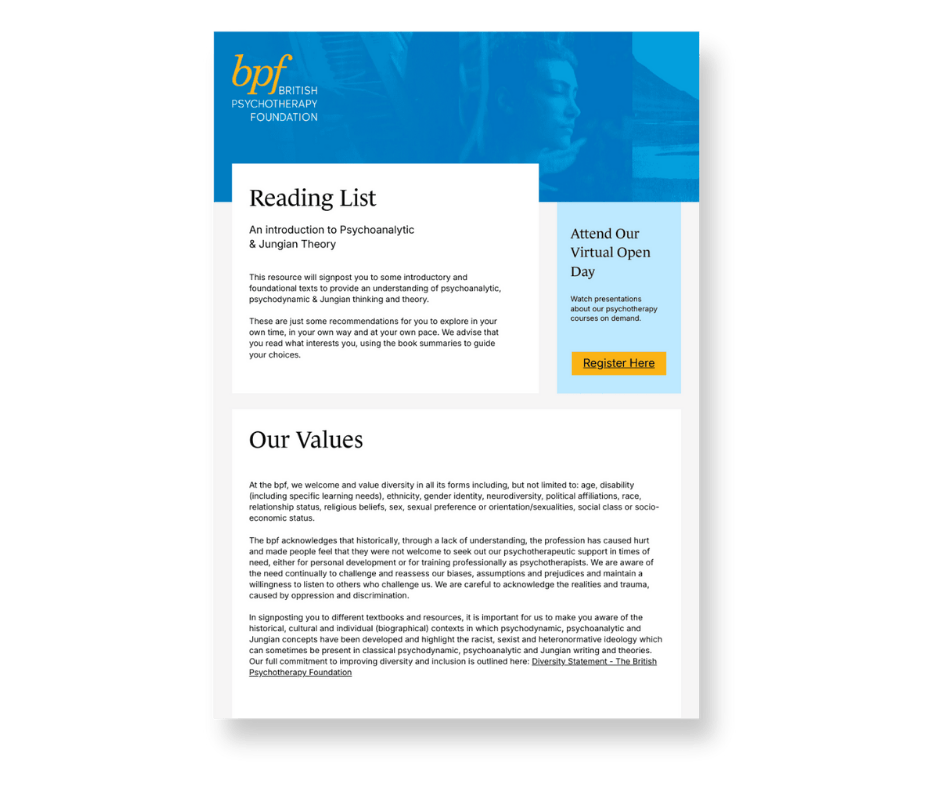
Reading List: Introduction to Psychoanalytic & Jungian Theory
Receive a curated list of 67 essential texts – covering psychoanalytic, psychodynamic, and Jungian theory – ideal for both newcomers and those wanting to deepen their knowledge.