Certificate in Psychodynamic Couple Theory
Hybrid learning – London and Online
Course length: 2 years
Forming the theoretical component of the clinical qualifying training in psychodynamic couple psychotherapy.
The British Psychotherapy Foundation (bpf) is now offering a more flexible route to training and qualification in psychodynamic couple psychotherapy.
The theoretical and clinical components of the training can now be undertaken separately. The theory programme may also be taken as a standalone CPD course for qualified clinicians wishing to deepen their understanding of psychodynamic work with couples.
This new structure may be of particular interest to practitioners who are unsure about embarking on a further clinical training immediately, or who wish to stagger the theory and clinical components over a longer period.
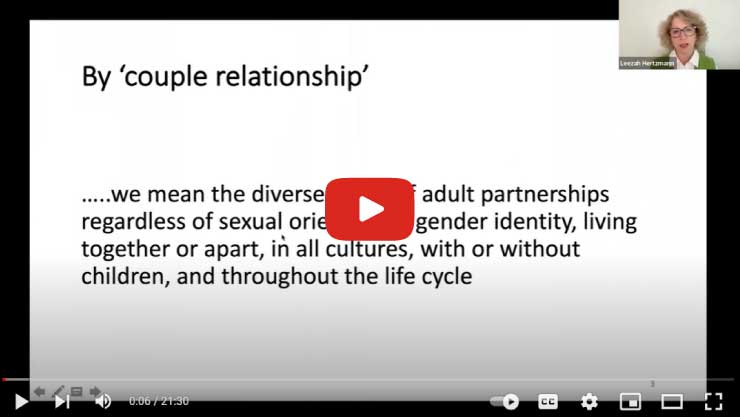
By ‘couple relationship’ we mean the diverse range of adult partnerships regardless of sexual orientation, gender identity, living together or apart, with or without children, and throughout the life cycle.
One of the unique features of this course is its contemporary psychoanalytic approach, including an emphasis on diversity, exploring the conscious and unconscious impact of discrimination on the couple relationship and between partners, such as homophobia, heteronormativity, racism, ageism, class etc.
This full version of training, including both the theoretical and clinical components, is accredited by the British Psychoanalytic Council (BPC).
- Course content
- Course structure
- Entry requirements
- Course fees
- Resources
- Access information
- How to apply
The Certificate in Psychodynamic Couple Theory provides a comprehensive introduction to psychoanalytic and psychodynamic thinking about couple relationships.
The course forms the theoretical component of the bpf’s qualifying clinical training in psychodynamic couple psychotherapy and offers an opportunity to engage deeply with contemporary and classical psychoanalytic approaches to couple dynamics, unconscious communication, attachment, sexuality, conflict, and emotional development within intimate relationships.
The programme is delivered through seminars across two years. Certificates are awarded following successful completion of Year 1 and Year 2.
There are no written assignments or formal written requirements.
The training is offered in a small-group setting, both in person and online. It aims to provide a thorough psychoanalytic understanding of the couple relationship including couple development, sexual relationships, working with unconscious couple dynamics and processes, psychopathology, clinical technique and so on. The course explores the conscious and unconscious impact of discrimination on the couple relationship (e.g. homophobia, racism, ageism, class, disability etc.).
The course structure is as follows:
- Hybrid delivery: online via Zoom and in person at bpf House
- Three terms of 10 weeks each
- Two in-person seminars per term
- Thursdays, 1.30 pm – 2.45 pm
Who is this Course For?
This course is suitable only for qualified:
- Psychoanalytic psychotherapists
- Psychodynamic psychotherapists
- Psychoanalysts
- Child psychotherapists
- Group psychotherapists
Applicants must be registered with one of the following professional bodies:
- Association of Child Psychotherapists (ACP)
- British Psychoanalytic Council (BPC)
- UK Council for Psychotherapy (UKCP)
Course Fees
Click here to view course fees
The annual fee for this course is £1,455 for non-members and £1,309 for bpf members.
Please note that fees are subject to annual increases in line with inflation in the UK.
Additional costs:
Application fee – £75
Personal therapy fees
Supervision fees
Trainee membership is compulsory whilst studying this course. This includes a subscription to PepWEB and eligibility to attend bpf events.
For more information about fees, and paying in instalments, please contact Sandra Pereira, CPPT Course Administrator: [email protected]
Attend our Virtual Open Day to watch a presentation about this course.
Blogs
Frequently Asked Questions About Psychodynamic Psychotherapy
How to become a psychotherapist in the UK – The British Psychotherapy Foundation
My Journey as a Black Trainee in Psychodynamic Psychotherapy – The British Psychotherapy Foundation
How Couples Psychotherapy Can Transform Relationships – The British Psychotherapy Foundation
Why become a psychotherapist? (part I)
Why become a psychotherapist? (part II)
Videos
What’s it like to be a psychotherapist? Psychoanalytic psychotherapist (youtube.com)
What’s it like to be a psychotherapist? Child and Adolescent Psychotherapist (youtube.com)
What’s it like to be a psychotherapist? Jungian Analyst (youtube.com)
The building has limited access – please call us on 020 8452 9823, or email [email protected], to discuss your needs.
Applicants should have acquainted themselves with the details of the course and its requirements for entry.
The final decision will be made following the application form and selection interviews.
- To apply, download an application form and submit it to: [email protected] by 26th June and attach your CV, a copy of your professional registration documents and qualifications (training certificates)
- An application fee of £75 is payable at the time of submitting your application form. If you wish to progress to the full Couple Psychodynamic Psychotherapy, you will be required to attend an additional interview, which carries a separate fee of £75. Please click here to make a payment.
- Those shortlisted will be invited to an interview.
- A final offer of a place on the training will be offered at the discretion of the interviewers.
The bpf is committed to diversity and inclusivity in all the work we deliver. We are fully dedicated to promoting, maintaining and supporting equality of opportunity in all aspects of our organisation and, as such, the bpf welcomes applications from all sections of society.
The standard of teaching was exceptional, and the course structure fostered an environment conducive to our growth and development as clinicians. Regular weekly supervision sessions allowed us to strengthen our peer relationships while deepening our learning.
bpf Student
Simply, it exceeded all my expectations, and sufficiently impressed and enthused me to consider a future career in psychotherapy. On a personal level it has changed me; something that has been accelerated by beginning my own personal analysis. I find myself thinking about non-verbal communications much more as a consequence of having attended the course.”
bpf Student
The course has allowed me to dip my toe into the analytic world and provided a broad overview of the analytic landscape. It has enhanced my understanding of psychoanalytic ideas and I’ve particularly benefited from speaking to experienced clinicians. The discussion groups in particular have been useful to clarify my own ideas and get a different perspective from others. Overall, it has helped me to determine if I would like to pursue work in this field.”
bpf Student
Last Chance to Apply for Autumn 2026 Start:
- Assessment Skills Training – (London, Starts 3rd October 2026)
- Foundation Course – Psychotherapy & Counselling – (London or Online, Starts October 2026)
- Certificate in Psychodynamic Couple Theory – (Hybrid – London & Online , Starts September 2026)
- Jungian Dreams Workshop – (Online via Zoom, Starts October 2026)
- Psychodynamic and Jungian Theory for Qualified Practitioners – (Taught Online, October 2026)
bpf North:
- Psychoanalytic & Psychodynamic Psychotherapy Training (Taught in Newcastle & Online, October 2026)
- Foundation Course (Taught in Newcastle, October 2026)
New in 2027:
- Freud: Advanced Studies (Taught in London from January 2027)
- Certificate in Autism and Mental Health (Taught online from January 2027)
- Diploma in Psychodynamic Supervision (Taught online from March 2027)
Upcoming Events
Foundation Course Open Evening – Wednesday 9 September 2026, 7.00–8.15pm BST, Online via Zoom. Meet course director Urvashi Chand, learn about the Foundation Course and its study options, and ask your questions. Click here to register.
When Societies Lose Their Minds – Date: 14/10/2026 Time: 19:00 – 21:00 GMT, Online via Zoom. Lord John Alderdice, Dr Gwen Adshead and Professor Josh Cohen explore violence at both an individual and societal level. Click here to register.

Make a £10 Donation – Receive a Psychoanalytic Reading List
Donating supports our mission to make our psychotherapy training, clinical services, and public events affordable, accessible, and more inclusive.
Reading List: Introduction to Psychoanalytic & Jungian Theory
Receive a curated list of 67 essential texts – covering psychoanalytic, psychodynamic, and Jungian theory – ideal for both newcomers and those wanting to deepen their knowledge.