Psychoanalytic Psychotherapy Training (PPA)
Intensive Psychoanalytic Training
In-person training: 37 Mapesbury Road, London NW2 4HJ. Part-time course.
The PPA training prepares therapists to work intensively at a minimum frequency of three times per week, allowing for a deep therapeutic experience that seeks to address the root causes of emotional distress beyond alleviating symptoms.
Our theory programme is grounded in the British Object Relations School, exploring the thinking and influence of Freud, Klein, Winnicott, Bion, the British Independents and Post-Kleinians, as well as contemporary contributions to psychoanalytic thinking and practice. Our focus is on the relevant application of psychoanalytic ideas in the present day, grounding modern thinking in a thorough understanding of the past.
Training begins with Year One: Freud: Advanced Studies, a year-long, in-depth engagement with Freud’s writing which also introduces the infant observation seminar. From Year Two, trainees participate in clinical and theory seminars, complete clinical and psychiatric placements, and prepare to begin work with training patients under supervision for a significant period of time.
For those wishing to apply for entry onto the PPA training, please visit our Freud: Advanced Studies page for full details of the course and how to apply.
New 2027 entry route
Freud: Advanced Studies
The bpf has developed a new entry route onto the PPA training: Freud: Advanced Studies, a year-long certificate course that now serves as Year One of the PPA training.
MES applicants may continue to apply at any point in the calendar year.
If you are interested in applying, please complete our questionnaire below:
For further information, please email [email protected].
Resources
- Course Content
- Course Structure
- Entry Requirements
- Fees
- Resources
- Access Information
- How to Apply
The PPA training prepares therapists to work intensively at a minimum frequency of three times per week, allowing for a deep therapeutic experience that seeks to address the root causes of emotional distress beyond alleviating symptoms.
Our theory programme is grounded in the British Object Relations School, exploring the thinking and influence of Freud, Klein, Winnicott, Bion, the British Independents and Post-Kleinians, as well as contemporary contributions to psychoanalytic thinking and practice. Our focus is on the relevant application of psychoanalytic ideas in the present day, grounding modern thinking in a thorough understanding of the past.
Training begins with Year One: Freud: Advanced Studies, a year-long, in-depth engagement with Freud’s writing which also introduces the infant observation seminar. From Year Two, trainees participate in clinical and theory seminars, complete clinical and psychiatric placements, and work with training patients under supervision for a significant period of time.
For those wishing to apply for entry onto the PPA training, please visit our Freud: Advanced Studies page for full details of the course and how to apply.
Training Routes
The Full Training is suitable for those who have not completed a previous psychotherapy training. Entry to the Full Training is via Freud: Advanced Studies, which serves as Year One.
The Modified Entry Scheme (MES) route is for those who already have a qualification in psychodynamic or psychoanalytic therapy as an adult therapist, child therapist or couple therapist, and have significant experience as an analysand in intensive work of at least 5 years duration. MES entrants join the training directly, bypassing Year One.
Qualified Psychodynamic Psychotherapists who have completed an equivalent curriculum, and who are already undertaking personal psychoanalytic psychotherapy or psychoanalysis at least three times per week with an approved therapist, may be considered for direct entry into Year Two. All applications are reviewed on an individual basis, and any offer of direct entry remains at the discretion of the PPA Training Committee.
The PPA Training Committee is responsible for all aspects of the training, including selection, curriculum and clinical work with training patients.
Each trainee is assigned a personal tutor who is a member of the Training Committee and who will support the trainee throughout their journey on the training. On Freud: Advanced Studies, this tutor is the same one described on that course’s own page, who will also be able to advise trainees on possible progression into Year Two.
The administration of the PPA Training is the responsibility of the bpf administrative team, working closely with the various PPA Committees and the different bpf teams.
The PPA qualifying course comprises:
- Year One: Freud: Advanced Studies, a year-long in-depth engagement with Freud’s writing, alongside a Work Discussion Group and the start of the Infant Observation seminar. See the Freud: Advanced Studies page for full details.
- Personal psychoanalytic psychotherapy/psychoanalysis at a minimum frequency of 3 times weekly with an approved PPA Training Therapist, in person, for the entire duration of the training.
- Infant Observation for a minimum of 12 months, if not already undertaken. This is required before proceeding to take training patients.
- A psychiatric placement undertaken for a minimum of half a day for 6 months.
- A clinical placement for those with limited previous experience.
- In-person attendance in weekly theory and clinical seminars over a minimum of 4 years (including Year One), and until the trainee is ready to qualify.
- Undertaking clinical work with at least two patients under supervision, 3 times weekly, for a period of 2 years and 18 months respectively.
- The submission of six-monthly reports and a final clinical paper.
Structure
Year One: Freud: Advanced Studies. Trainees attend a theory seminar on Freud’s writing every Tuesday from 6.30pm to 8.00pm, followed by a Work Discussion Group from 8.15pm to 9.45pm, and a separate weekly Infant Observation seminar (which can take place online). There are no clinical seminars in Year One, as trainees do not yet see training patients. See the Freud: Advanced Studies page for full structure details.
Clinical and Theory Seminars (Year Two onwards)
From Year Two, Clinical and Theory Seminars run every Tuesday evening during term time from 6.30pm to 9.45pm and take place in person. Each term includes two Saturday seminars and one plenary session with the PPA Training Committee.
Those completing an Infant Observation attend a further seminar per week; for most trainees, this begins in Year One as part of Freud: Advanced Studies.
Clinical seminars run from 6.30pm to 8.00pm from Year Two onwards, and are attended until qualification. Trainees bring material from their clinical work, whether undertaken during a placement, professional role or clinical practice.
Theory Seminars, including Year One’s Freud: Advanced Studies, are attended for four years in total and cover core psychoanalytic theory. From Year Two, they take place from 8.15pm to 9.45pm and on two Saturday mornings each term.
Throughout the training, all seminars offer a space to discuss clinical work with experienced seminar leaders from different psychoanalytic orientations, with a focus on working psychoanalytically and mindfully from a place of understanding.
Training Patients
Trainees usually begin seeing their first training patient from the second year on the training, after completing a psychiatric placement and an infant observation. Both patients must be seen three times per week – one for at least two years and the other for at least 18 months. Every six months, trainees write a report on each case and discuss these reports during a termly seminar.
All clinical work must be supervised weekly in one-to-one sessions with an approved Training Supervisor until qualification.
In special cases, trainees who are themselves in four- or five-times weekly analysis may be allowed to see training patients four times a week.
The requirements below apply to entry via Year One (Freud: Advanced Studies) and to direct entry into Year Two. For Modified Entry Scheme (MES) requirements, see the PPA MES page.
Personal Psychotherapy
Personal psychotherapy is essential for developing as a psychoanalytic psychotherapist. Trainees must have a solid understanding of their own emotional life in order to work safely and professionally with patients.
All trainees are required to be in psychoanalytic psychotherapy at least three times a week from the start of training until qualification, with an approved PPA Training Therapist.
Most applicants are already in intensive personal therapy before applying. If not, the PPA can help you find an approved training therapist.
Applicants come from a wide range of backgrounds, including mental health and related professions, academia and the arts. Candidates are chosen based on their potential to learn and work effectively as psychoanalytic psychotherapists. Each application is carefully reviewed individually.
Relevant Experience
- One-to-one experience supporting adults with emotional difficulties (professional or voluntary).
- An academic qualification is common but not required if the applicant can demonstrate academic capability at postgraduate level.
- Familiarity with psychoanalytic ideas.
- Applicants without psychiatric experience must complete a psychiatric placement (before or during training).
- Applicants with limited clinical experience must complete a clinical placement, at the discretion of the Training Committee.
Infant Observation
Trainees gain direct experience of early emotional life by observing a mother and baby at home, once a week, for an hour. This helps develop the ability to notice early states of mind, nonverbal communication, and one’s own emotional responses. The observer learns to tolerate being both intimately involved with an infant and family, and able to observe from a position of thoughtful separateness, a vital preparation for clinical work.
These observations begin at birth and last one or two years, depending on what is agreed with the family. Trainees write detailed weekly notes and discuss them in a seminar led by an experienced psychotherapist. A written piece based on the observation must be completed before starting work with the first training patient
Find more information on our Infant Observation course here.
Residence and Language
All applicants for the PPA training are required to hold indefinite right to remain (ILR) in the UK, and to be in a position to support themselves financially during the training, which is an intensive clinical programme requiring long-term, in-person work with training patients.
Please note that current student and/or any other time-limited visas do not meet the entry requirements for the PPA training.
In order to attain qualification with the PPA, candidates are required to undertake long-term, in-person clinical work with training patients. Typically, trainees require five years or more to complete the programme. As this programme does not confer eligibility for a visa, we are unable to consider applications from individuals who do not possess indefinite leave to remain (ILR) in the United Kingdom.
The PPA training is delivered in English. Where English is not their first language, applicants may be asked to demonstrate that their use of spoken and written English is sufficient to participate in the academic and clinical components of the course.
Successful applicants will need to apply for a DBS check or provide a valid certificate. For more information, please visit our Training FAQs page here: Training FAQs – The British Psychotherapy Foundation.
Fees
Undertaking a clinical training in Psychoanalytic Psychotherapy represents a major personal investment in terms of time, finances and individual development.
We are currently unable to offer financial support to trainees. However, we review our fees regularly with the aim to keep them as affordable as possible. The bpf does not subsidise transport or accommodation expenses.
| (PPA) Psychoanalytic Psychotherapy | Year 1 (Freud: Advanced Studies) | 4488* |
| Years 2-4 | 4488* | |
| Year 5+ | 2193* |
The Certificate Route on Freud: Advanced Studies has a different course fee.
Personal therapy and supervision are not included in the course fees. The cost of personal therapy is negotiated with the Training Therapist on an individual basis. Similarly, when beginning to work with training patients, the cost of supervision will be discussed with each Training Supervisor. Trainees will need to provide an appropriate setting to see training patients, and this may involve room rental costs.
Course fees are subject to annual increase. A full academic year consists of 3 terms.
- If clinical work needs to continue beyond the four years of the training, there is a reduction in the annual fee (subject to annual increase).
- If an Infant Observation is undertaken during the course, there is an additional fee.
- Trainees also pay an annual bpf membership fee, which provides access to the bpf library, to PEPWEB (an excellent online resource of psychoanalytic literature), and access to bpf’s wide-ranging scientific and cultural life. This is now included in the course fee.
Ilse Seglow Bursary Fund
In memory of Ilse Seglow (1900-1984) her family has set up a bursary. This is intended to provide financial support to those with limited means so enabling them to further their professional development and training in psychoanalytically orientated psychotherapy.
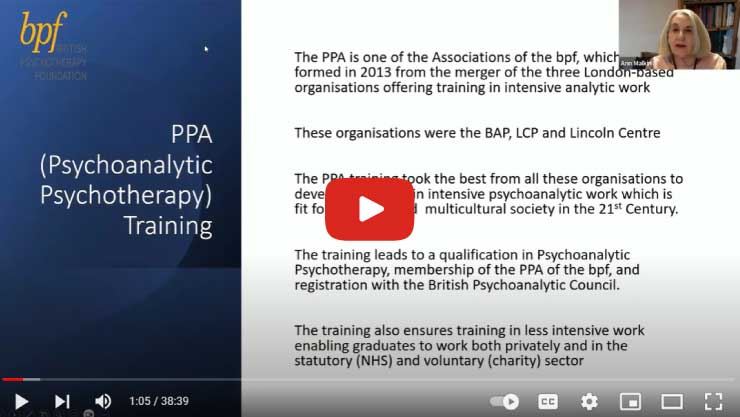
PPA Curriculum
Attend our Virtual Open Day to watch a presentation about this course.
Blogs
Frequently Asked Questions About Psychodynamic Psychotherapy
How to become a psychotherapist in the UK – The British Psychotherapy Foundation
My Journey as a Black Trainee in Psychodynamic Psychotherapy – The British Psychotherapy Foundation
How Couples Psychotherapy Can Transform Relationships – The British Psychotherapy Foundation
Why become a psychotherapist? (part I)
Why become a psychotherapist? (part II)
Videos
What’s it like to be a psychotherapist? Psychoanalytic psychotherapist (youtube.com)
What’s it like to be a psychotherapist? Child and Adolescent Psychotherapist (youtube.com)
What’s it like to be a psychotherapist? Jungian Analyst (youtube.com)
Contact us at [email protected] to discuss any access requirements.
There are three ways to join the PPA training:
- Year One (standard entry): apply to Freud: Advanced Studies, our year-long certificate course which now serves as Year One of the training. Visit the Freud: Advanced Studies page for full details, entry requirements and how to apply — applicants for the clinical route there apply via the PPA Questionnaire.
- Modified Entry Scheme (MES): for qualified adult, child or couple therapists with at least 5 years of intensive personal therapy, bypassing Year One entirely. MES applicants may apply at any point in the calendar year — see our PPA MES page for details.
- Direct entry to Year Two: qualified Psychodynamic Psychotherapists already in personal psychoanalytic psychotherapy at three or more times weekly, and who have started, or are about to start, an infant observation, may be considered for entry directly into Year Two. Please use the questionnaire below or email us to discuss.
If you are applying via MES or for direct entry to Year Two, please complete our preliminary questionnaire below:
Once received, we will be in touch with you to schedule a call with a member of our Training Committee to discuss your circumstances in more detail.
MES applicants: please note the MES intake begins in September 2026. The preliminary application deadline is set for 13 April 2026.
Application Stages (MES and Direct Year Two Entry)
- Preliminary questionnaire
- Informal discussion with a member of the PPA Training Committee
- Submission of an Application Form (if recommended)
- Undertaking two or more interviews with an experienced clinician, as required
- Outcome
Application fee: £170
If you have any queries, please contact the PPA Training Manager on [email protected].
For Year One applicants, please see the application process, fees and stages set out on the Freud: Advanced Studies page.
Please ensure you have carefully read the information on the PPA pages of the bpf website including the entry requirements.
The bpf is committed to diversity and inclusivity in all the work we deliver. We are fully dedicated to promoting, maintaining and supporting equality of opportunity in all aspects of our organisation and, as such, the bpf welcomes applications from all sections of society.
Free Online Course
Into the Depths: A Psychoanalytic and Jungian Introduction to the Mind
Starts 2 November 2026 on FutureLearn
Explore love, family, dreams, trauma and death with seven bpf psychotherapists from the psychoanalytic and Jungian traditions. This free six-week online course, designed by the bpf for FutureLearn, offers an introduction to the psychology of the unconscious for anyone curious about how the mind works.

Apply to start in 2027
- Freud: Advanced Studies Taught in London from Sep 2027
- Certificate in Autism and Mental Health Online from Jan 2027
- Diploma in Psychodynamic Supervision Online from Mar 2027
- Summer School: Foundations of Psychoanalytic & Jungian Psychotherapy Online, Summer 2027
- Experiential Weekend: An Introduction to Psychoanalytic and Jungian Thinking In-person, November 2027
- Experiential Weekend: Deepening Analytic PracticeIn-person, October 2027
- Work Discussion: Understanding Children and Families from a Psychoanalytic Perspective Online, September 2027
- Psychiatry for Psychotherapists In-person, 2027
Upcoming Events
Hierarchies and Fragmentations in Psychoanalysis: In-person Conference – 21 November 2026 | 10.00am – 5.00pm. Location: London (LIFT Islington). A conference exploring how psychoanalysis and Jungian analysis can evolve, adapt and thrive in the 21st century. Click here to register.

Make a £10 Donation – Receive a Psychoanalytic Reading List
Donating supports our mission to make our psychotherapy training, clinical services, and public events affordable, accessible, and more inclusive.
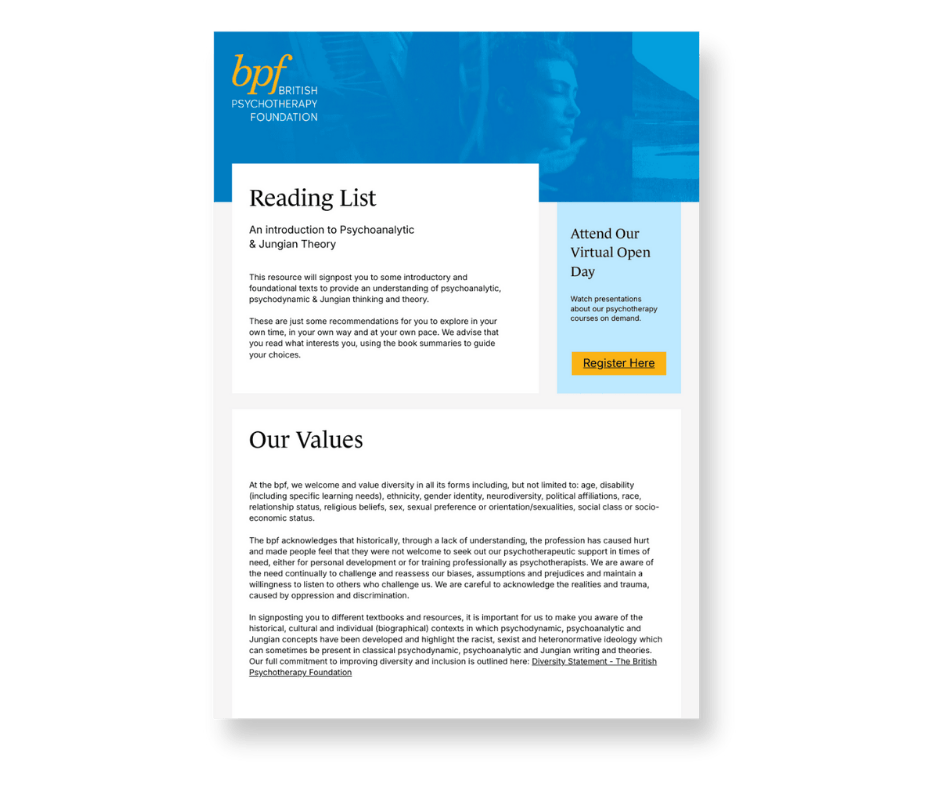
Reading List: Introduction to Psychoanalytic & Jungian Theory
Receive a curated list of 67 essential texts – covering psychoanalytic, psychodynamic, and Jungian theory – ideal for both newcomers and those wanting to deepen their knowledge.